# Jusung profit surges 426%, driven by 214 billion won ALD backlog
*Third-quarter operating income jumped to 17.67 billion won as semiconductor equipment deliveries generated 98.2% of the South Korean supplier's nine-month revenue.*
**Published:** November 15, 2026
**By:** Ji-woo Han
**Section:** Semiconductors & AI Hardware — South Korea
**Format:** Company Watch
**Confidence:** high
**Source:** https://eastasiabrief.com/semiconductors/jusung-profit-surges-426-driven-214-billion-won-ald-1451
**Publisher:** East Asia Brief (https://eastasiabrief.com/)
---
## What to know
- Backlog reaches 214.4 billion won as Q3 operating profit rises 426%
- Semiconductor tools generate 98.2% of nine-month sales at 189.4 billion won
- Final third-quarter report submission deadline scheduled for Nov. 14
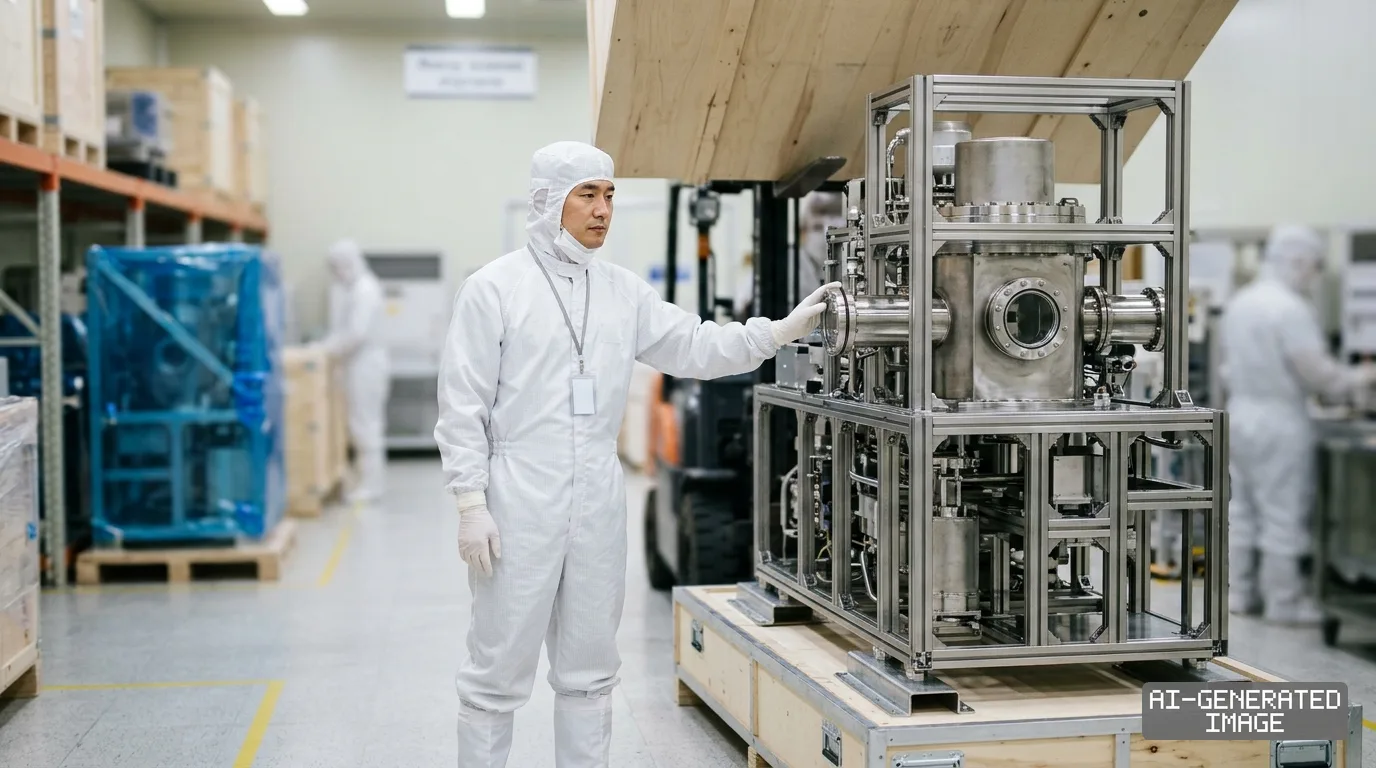
*A technician in cleanroom attire examines semiconductor manufacturing equipment mounted on a wooden crate inside a facility. (AI-generated image)*
Jusung Engineering accelerated shipments of its high-dielectric atomic layer deposition tools on Nov. 9, 2026, as third-quarter deliveries converted a semiconductor equipment order backlog that reached 214.4 billion won.
The equipment maker booked 78.08 billion won ($56.5 million) in third-quarter revenue, an increase of 32.8% from a year earlier. Operating profit surged 426.4% to 17.67 billion won, according to regulatory filings.
Semiconductor manufacturing equipment generated 189.4 billion won ($137 million) in sales through September. That accounted for 98.2% of the company's 192.8 billion won in cumulative revenue across the first nine months.
The front-end order backlog climbed from 88.5 billion won at year-end 2025 to 214.4 billion won by June 30. That backlog represented 91.8% of the company's 233.6 billion won in total manufacturing commitments.
The sharp expansion in manufacturing commitments reflected memory fabricators preparing for node transitions. Chipmakers are investing heavily to retool older wafer fabrication facilities into advanced dynamic random-access memory lines.
Revenue recognition in the front-end equipment sector operates strictly on delivery basis terms. Equipment sales register on financial statements only after tools arrive on site, undergo installation and pass customer acceptance tests.
Delivery lags between cleanroom construction and equipment move-in depressed first-half revenue across the Korean equipment sector. Move-in activity accelerated through the summer as memory makers finished facility buildouts in South Korea and overseas.
First-quarter operations posted an operating loss of 7.0 billion won due to facility scheduling delays. Second-quarter operations returned to profitability with an operating profit of 1.42 billion won, establishing an operating margin of 2.4%.
The third-quarter turnaround to 17.67 billion won in operating profit demonstrated the operating leverage inherent to high-margin deposition equipment. Fixed research and development overhead eased as factory shipments scaled up.
Atomic layer deposition — a vapor process laying chemical films onto silicon wafers one atomic layer at a time — drives the company's core product line. The technique provides precise film thickness control on microscopic surfaces.
Memory fabricators rely on high-dielectric materials — compounds known as High-k that store electrical charge without breaking down — inside memory capacitors. These microscopic structures preserve individual data bits inside DRAM chips.
Circuit shrinking below 10 nanometers forces capacitor structures to extend upward, creating extreme aspect ratios. Coating these narrow vertical channels requires chemical uniformity across three dimensions, multiplying the number of atomic deposition cycles required per wafer.
SK hynix represents the company's primary domestic buyer for capacitor deposition systems. The memory manufacturer uses space-divided plasma deposition tools to manufacture high-bandwidth memory products and high-density computing chips.
Capital spending allocations by SK hynix at its M15X fab in Cheongju dictate procurement timing for domestic suppliers. The manufacturer is directing capital toward advanced packaging and high-density memory lines.
Beyond capacitor ALD, the company shipped an integrated atomic layer growth system to a global memory manufacturer on May 18. The tool targets structural limits encountered in next-generation vertical transistor fabrication.
Atomic layer growth — a process where crystalline films nucleate and grow selectively from chemical surface sites — allows three-dimensional lattice formation. The technique creates uniform conducting layers where traditional downward vapor deposition fails.
The equipment builder has sought to diversify beyond memory into leading-edge logic foundries. Engineers developed low-temperature plasma deposition systems to form gate dielectrics in nanosheet transistor structures.
The company has not filed regulatory disclosures confirming commercial purchase orders or tool shipments for leading-edge logic foundries, despite market speculation surrounding qualification testing. Official filings cite non-disclosure agreements that withhold client names.
Display manufacturing equipment generated 2.2 billion won in first-half revenue, declining as panel makers restrained factory outlays. Solar cell equipment order backlogs stood at zero won as of June 30.
The absence of non-semiconductor business leaves the company dependent on chip capital expenditures. Financial debt remained manageable, with the company's debt-to-equity ratio closing the second quarter at 46.4%.
Shipments to Chinese memory manufacturers also contributed to unbilled equipment flows during the summer quarter. Those shipments face continuous scrutiny as international export control standards governing advanced semiconductor tooling evolve across East Asia.
The company faces its next regulatory disclosure deadline on Nov. 14, when South Korean exchange rules require listed manufacturers to submit finalized third-quarter quarterly reports detailing operational cash flows.
Cleanroom installation schedules will govern fourth-quarter revenue recognition. Customer inspection timelines will determine how quickly remaining backlogs translate into recognized annual revenue.
## Impact map
| Event | Korea | China | Japan | Global impact |
| --- | --- | --- | --- | --- |
| ALD tool shipment ramp | SK hynix draws High-k capacitor tools for M15X fab buildout | Legacy DRAM fabricators take tool deliveries under current export thresholds | Deposition materials suppliers Tokyo Ohka and JSR see precursor demand climb | Advanced DRAM capacitor deposition capacity expands across 10nm-class nodes |
## In this story
- **Companies:** Jusung Engineering
- **Tickers:** 036930.KS
- **Exposed:** SK hynix
- **Impact:** Supply Chain, Capex, Order Book
## Primary sources
1. fss.or.kr
2. munhwa.com
3. mk.co.kr
4. leadeconomy.co.kr
5. thelec.kr
---
Cite as: East Asia Brief, "Jusung profit surges 426%, driven by 214 billion won ALD backlog," November 15, 2026. https://eastasiabrief.com/semiconductors/jusung-profit-surges-426-driven-214-billion-won-ald-1451