# Yaskawa Electric sets 2030 rollout for industrial humanoids
*The Japanese servo motor pioneer is shifting motion platforms toward physical AI as subsidiary Tokyo Robotics accelerates bipedal hardware trials.*
**Published:** October 14, 2026
**By:** Aiko Tanaka
**Section:** Robotics & Automation — Japan
**Source:** https://eastasiabrief.com/robotics/yaskawa-electric-sets-2030-rollout-industrial-humanoids-710
**Publisher:** East Asia Brief (https://eastasiabrief.com/)
---
## What to know
- The Kitakyushu-based manufacturer is directing 250 billion yen ($1.
- Strategic investments account for 120 billion yen ($804 million) of that capital plan.
- Yaskawa Electric holds roughly 15% of the global industrial robotics market, competing directly with Fanuc and ABB.
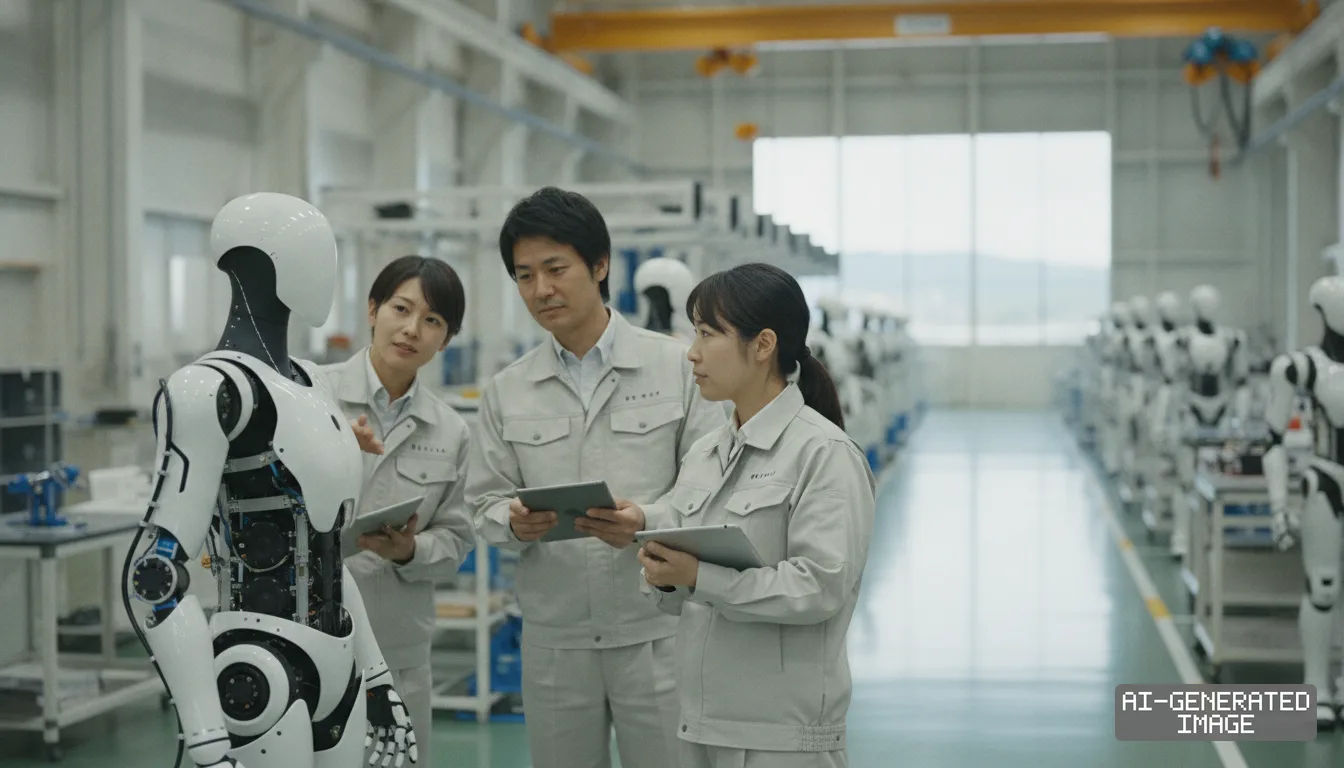
*Engineers holding digital tablets examine an industrial humanoid robot inside a manufacturing facility. (AI-generated image)*
Yaskawa Electric outlined steps on Oct. 14, 2026, to commercialize industrial humanoid robots by 2030, pivoting its motion-control hardware toward factory automation powered by physical artificial intelligence.
The Kitakyushu-based manufacturer is directing 250 billion yen ($1.67 billion) in capital spending and strategic investments through fiscal 2029 under its Dash 35 plan. The allocation funds new torque-dense actuators and lightweight robotic joints.
Strategic investments account for 120 billion yen ($804 million) of that capital plan. The capital program supports an operating profit target of 100 billion yen ($670 million) for the fiscal year ending February 2030.
Yaskawa Electric holds roughly 15% of the global industrial robotics market, competing directly with Fanuc and ABB. The company built its manufacturing base on AC servo motors and variable-frequency inverter drives.
Those factory systems traditionally operate on deterministic code where machine paths are pre-programmed. The rise of physical AI requires actuators that adjust torque instantly to handle unexpected contact and complex assembly.
Humanoid platforms demand high torque density in tight mechanical footprints. Traditional six-axis arms distribute servomotors across rigid frames, but bipedal frames require integrated rotary actuators to prevent thermal throttling.
To secure that hardware architecture, Yaskawa Electric acquired full ownership of Tokyo Robotics on July 1, 2025. The Waseda University spinoff designs the Torobo bipedal humanoid and specializes in compliant joint control.
Tokyo Robotics integrates whole-body passive compliance — mechanical flexibility that absorbs impacts safely — through custom strain-wave gearing and dual-encoder feedback. That mechanism prevents joint motor burnout during uneven foot strikes.
In supplementary filings on Oct. 9, Yaskawa Electric confirmed that Tokyo Robotics will accelerate site verification in the second half of fiscal 2026. The trials focus on data collection and structural design.
The engineering cohort is testing bipedal robots inside controlled factory environments. Engineers are gathering joint load telemetry to refine structural balance across prolonged material handling shifts.
Software integration advances on a parallel track. Yaskawa Electric released an agentic robot system on July 15 that pairs its MOTOMAN NEXT controller with Google DeepMind's Gemini Robotics ER 1.6 vision-language model.
The system allows robotic limbs to interpret spatial instructions without manual coordinate programming. Humanoid frames require that software autonomy to navigate cluttered aisles and pick unoriented industrial parts.
Yaskawa Electric updated its fiscal 2026 earnings forecast on Oct. 9, raising sales expectations on foreign exchange gains while lowering operating profit projections due to upfront development expenses.
Japanese component makers face rising competition from Chinese humanoid developers. Chinese builders benefit from subsidized supply chains for frameless motors and planetary reduction gears in the lower price tier.
Yaskawa Electric is responding by positioning its industrial servo engineering as the premium tier. Factory operators require mean-time-between-failure ratings exceeding 20,000 operational hours before replacing fixed automation cells with walking robots.
Precision gearboxes from Harmonic Drive Systems and cycloidal drives from Nabtesco supply critical mechanical torque across Yaskawa's joint assemblies. A shift to humanoids multiplies actuator counts per unit from six to over 30.
That hardware density shifts margin capture from arm structural steel to joint actuation modules. Standard industrial robots require six actuators, whereas a full humanoid body consumes between 28 and 40 precision motors.
Automotive final assembly lines represent the primary deployment target. Car manufacturers need walking platforms to carry harnesses and install interior fasteners in spaces where wheeled chassis cannot navigate.
Electronics contract manufacturers are also testing compliant dual-arm manipulation. Humanoid torsos mounted on bipedal or wheeled bases can swap between soldering and box palletizing without line retooling.
The corporate plan schedules field testing to run through Feb. 28, 2027, the conclusion of the company's fiscal second half. Yaskawa Electric plans pilot demonstrations with Japanese manufacturing partners before offering external trial leases.
The company did not issue an independent humanoid roadmap document on Oct. 14, and Yaskawa has not published unit shipment targets or pricing for the commercial platform.
## Primary sources
1. huroc.org
2. digitimes.com
3. yaskawa-global.com
4. biz-journal.jp
5. yaskawa.co.jp
---
Cite as: East Asia Brief, "Yaskawa Electric sets 2030 rollout for industrial humanoids," October 14, 2026. https://eastasiabrief.com/robotics/yaskawa-electric-sets-2030-rollout-industrial-humanoids-710