# IndexBox projects delta robot market will double by 2035
*Baseline projections show parallel-link automation growing 7.7% annually as food processors and electronics assembly lines turn to high-speed pick-and-place arms to offset factory labor shortages.*
**Published:** September 27, 2026
**By:** Mina Okoro
**Section:** Robotics & Automation — Cross-border
**Format:** Why It Matters
**Confidence:** medium
**Source:** https://eastasiabrief.com/robotics/indexbox-projects-delta-robot-market-will-double-2035-389
**Publisher:** East Asia Brief (https://eastasiabrief.com/)
---
## What to know
- IndexBox projects the delta robot market index will rise from 100 in 2025 to 210 by 2035 at a 7.7% CAGR
- Packaging and logistics operations represent an estimated 20% share of total demand as speeds reach 200 cycles per minute
- IndexBox issues its next quarterly packaging automation dataset on Dec. 15, 2026
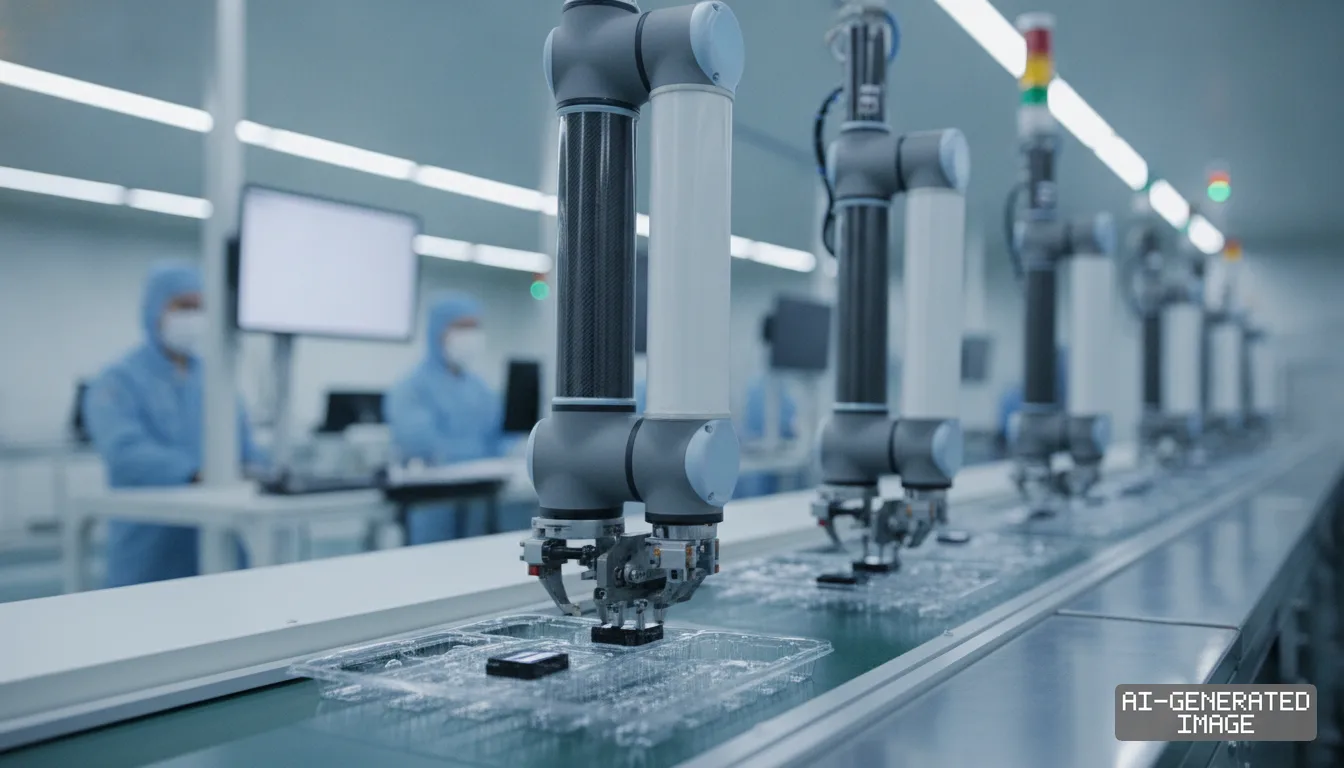
*Robotic arms place small components into trays on an automated conveyor line inside a cleanroom manufacturing facility. (AI-generated image)*
IndexBox said Sept. 26 that global demand for parallel-link delta robots will more than double over the next decade as food and electronics manufacturers automate high-speed assembly and packaging.
The market intelligence agency projects that the global delta robot market index will climb from 100 in 2025 to roughly 210 by 2035 under its baseline scenario. That expansion represents a 7.7% compound annual growth rate, IndexBox said.
Packaging and logistics operations will account for an estimated 20% share of total robot shipments across the forecast period. Surging order fulfillment volumes in retail distribution hubs drive that equipment demand, the agency said.
Delta robots employ three parallel arms mounted to a stationary base directly above the conveyor. The mechanical layout keeps heavy electric servo motors in the overhead base, leaving only lightweight carbon-fiber linkages to move above the line.
By minimizing the physical weight of moving parts, the parallel-link structure achieves rapid pick-and-place speeds that conventional articulated arms cannot match. The machines frequently sustain throughput rates exceeding 150 picks per minute during routine sorting operations, engineers note.
High-performance delta systems reach operational speeds of 200 cycles per minute under continuous factory conditions. That mechanical speed makes the robots a standard installation across bottling facilities, confectionery packaging lines and electronics assembly cells, according to the report.
Japanese automation maker Omron Corporation designs parallel-link arms capable of executing up to 200 cycles per minute with two-kilogram payloads. Omron pairs the mechanical hardware with machine controllers that operate up to eight delta units simultaneously, company technical specifications show.
Swiss industrial equipment maker ABB supplies delta robots that pick products at rates reaching 200 cycles per minute across a one-meter working radius. ABB configures the stainless-steel units for primary packaging lines where hygiene requirements prevent manual handling, company disclosures show.
Japanese robotics builder Fanuc Corporation integrates digital line-tracking vision tools directly into its high-speed delta series. The integrated optical software enables automated grippers to identify and retrieve randomly oriented items from moving conveyors without stopping belts, Fanuc documentation shows.
Food and beverage processors represent one of the primary buyer segments driving delta installations. Stricter health inspection standards and shrinking pools of manual packaging labor are pushing food processing plants toward automated handling lines, IndexBox said.
Food processors require robots rated IP65 or higher — an engineering classification confirming resistance to dust intrusion and low-pressure water sprays. The sealed enclosures permit production teams to wash down the arms with caustic chemical sanitizers between processing shifts, the agency said.
Pharmaceutical manufacturers also install washdown-capable delta robots to handle blister packs, medical vials and surgical syringes. The machinery eliminates physical human contact in cleanroom packaging areas, reducing contamination risks during high-speed batch transfers, according to the report.
Electronics assembly plants represent the second major driver of delta robot shipments through 2035. Plant managers deploy parallel-link robots to place delicate surface-mount devices, connectors and battery cells into consumer hardware enclosures, IndexBox said.
The physical miniaturization of consumer electronics makes manual placement impractical on fast-moving assembly belts. Robotic vacuum grippers position miniature electronic components within tolerances under 0.2 millimeters while maintaining sub-second cycle times, manufacturing datasheets indicate.
Advanced vision systems and artificial intelligence algorithms are expanding the range of items delta arms can process. Optical cameras suspended over conveyor belts capture images of incoming parts and calculate three-dimensional spatial coordinates in milliseconds, engineers explain.
These computational vision systems guide delta grippers during random bin-picking tasks, where unstructured items arrive in jumbled heaps. The software detects product orientation and selects an optimal grasp angle without halting the conveyor, according to the report.
E-commerce fulfillment centers are investing in delta picking cells to manage variable order mixes. Distribution facilities require automation hardware that can switch between fragile plastic blister packs, paper envelopes and rigid boxes without physical retooling between shifts, IndexBox said.
Persistent factory labor shortages across North America, Europe and East Asia are compressing payback schedules for automated packaging equipment. Rising hourly wages and high worker turnover make robotic packaging investments cost-effective within 18 to 24 months, industry data indicate.
High capital costs and system integration complexities remain the primary hurdles for prospective buyers. Small and medium-sized processors often face high upfront integration expenses and a regional deficit of engineers skilled in programming industrial delta robotics, the agency said.
Robotics developers are also introducing collaborative delta robots that incorporate sensitive torque sensors. The sensory mechanisms detect unexpected contact and stop motion instantly, allowing human operators and automated picking arms to work within shared spaces without perimeter fencing, IndexBox said.
The research agency did not publish the total nominal dollar value of the delta robot market for 2035 in its public summary. IndexBox withheld absolute currency figures and detailed country revenue breakdowns for its commercial database subscribers.
IndexBox will release its next quarterly update on global packaging machinery tracking on Dec. 15, 2026. Stricter European packaging hygiene and traceability standards take effect across member states on Jan. 1, 2027.
## Impact map
| Event | Korea | China | Japan | Global impact |
| --- | --- | --- | --- | --- |
| delta robot adoption | electronics subcontractors deploy high-speed arms to cut assembly cycle times | component suppliers invest in vision-guided delta cells to offset rising factory wages | Fanuc and Omron expand delta robot production as food and packaging orders rise | packaging lines lift throughput past 150 picks per minute to offset factory labor deficits |
## In this story
- **Companies:** Omron Corporation, ABB, Fanuc Corporation
- **Tickers:** 6645.T, 6954.T
- **Policy:** Economic Security
- **Impact:** Supply Chain, Capex, Cost Structure
## Primary sources
1. indexbox.io
2. digikey.in
3. scribd.com
4. parallelmanipulator.com
5. meetthetacs.ca
---
Cite as: East Asia Brief, "IndexBox projects delta robot market will double by 2035," September 27, 2026. https://eastasiabrief.com/robotics/indexbox-projects-delta-robot-market-will-double-2035-389