# Honpine Integrates Torque Sensors in Humanoid Robot Joints
*The Suzhou motion supplier detailed its TCHL harmonic actuator series on Nov. 4, integrating hollow wiring and dual absolute encoders into 0.5-kilogram joint units.*
**Published:** November 4, 2026
**By:** Xiuying Luo
**Section:** Robotics & Automation — China
**Format:** Breaking
**Confidence:** medium
**Source:** https://eastasiabrief.com/robotics/honpine-integrates-torque-sensors-humanoid-robot-joints-1127
**Publisher:** East Asia Brief (https://eastasiabrief.com/)
---
## What to know
- Honpine detailed its TCHL integrated harmonic joint module with internal torque sensing on Nov. 4
- Size 14 module weighs 0.5 kilograms within a series spanning 3.6 to 267 newton-meters
- Evaluation trials run through Dec. 31, while unit pricing and volume figures remain unpublished
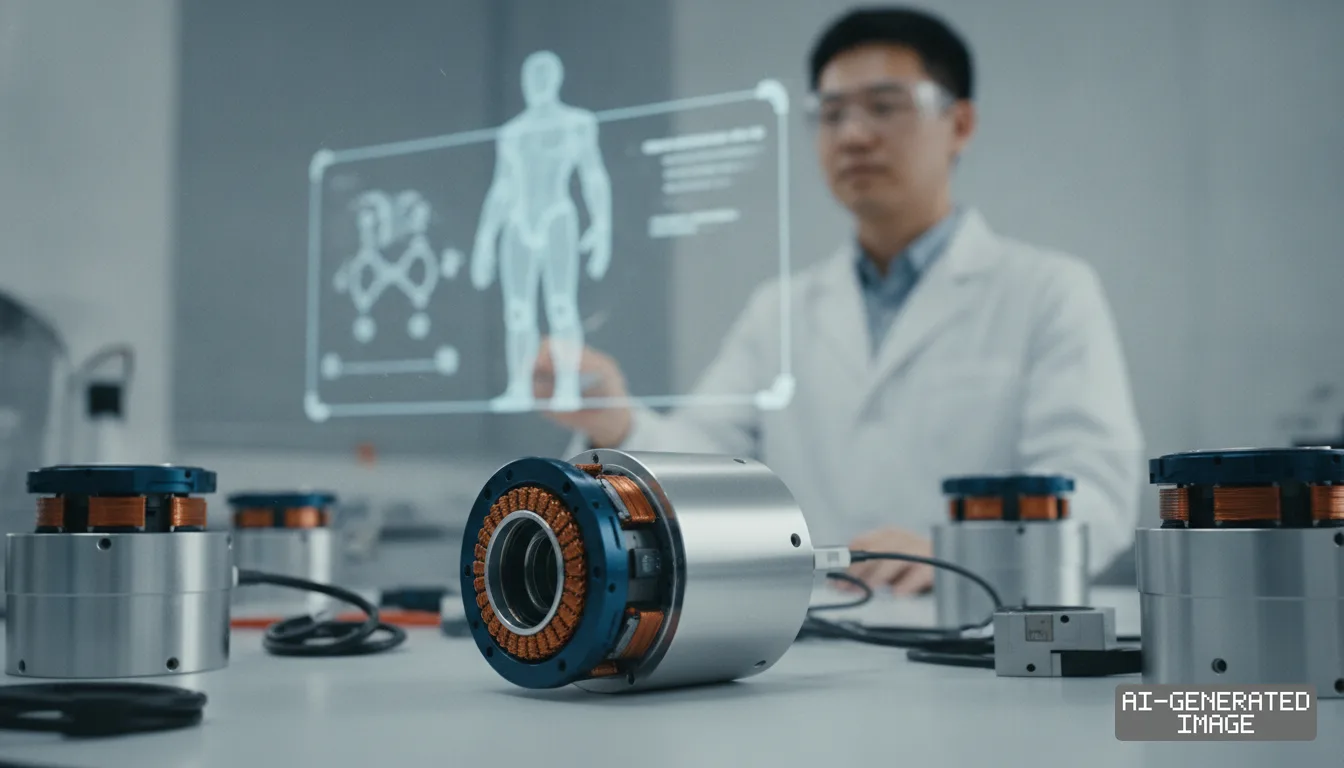
*Cylindrical robotic joint modules sit on a workbench as a technician in a lab coat reviews a humanoid robot schematic on a digital display. (AI-generated image)*
Suzhou Honpine Precision Industry Co., Ltd. on Nov. 4, 2026 published technical specifications for its TCHL harmonic joint module, marketing an integrated torque-sensing actuator for humanoid robot manufacturers.
The Suzhou-based supplier packages a strain-wave reducer, a frameless motor, dual encoders and a torque sensor into a single cylindrical casing. The assembly removes the need for separate external force transducers at each limb articulation.
The Size 14 model weighs 0.5 kilograms, representing the lightest tier of a product family spanning 52 millimeters to 131 millimeters in outer diameter and 3.6 to 267 newton-meters in rated output torque. The platform is designed for dynamic humanoid limbs.
Integrating torque sensors directly into the output stage of the harmonic drive allows the module to measure external contact loads. Robotic systems can then execute compliant motion without relying on motor current estimates.
Motor current sensing often masks mechanical friction and transmission windup, the company said. That limitation degrades tactile sensitivity when a bipedal robot walks across uneven ground or handles fragile objects.
Honpine paired the internal sensor with a 17-bit single-turn absolute encoder positioned on the output shaft. That unit operates alongside a primary motor-side encoder to establish a dual feedback loop.
The secondary encoder tracks the real position of the limb after the gearbox. That arrangement prevents tracking drift caused by flexspline deflection under load, holding total transmission error within 60 arcseconds across the operating envelope.
Humanoid developers are pressing component suppliers for integrated joint packages to shorten prototype assembly schedules. Building joints from discrete motors, bearings and sensors typically requires custom housings and weeks of manual shimming.
The TCHL architecture also incorporates drive control electronics directly into the module casing. The design accepts DC 48-volt power inputs and supports EtherCAT and CAN FD industrial communication protocols.
Cable management represents another bottleneck for bipedal machines carrying more than 30 individual motor joints. Exposed wiring harnesses often flex repeatedly and fail during rapid gait cycles.
Honpine addressed that failure mode by adding an axial hollow bore from Size 14 upward. The central passage allows internal routing of DC bus cables and signal lines directly through the joint axis.
All electrical connectors and internal lines are sealed inside the chassis. The casing provides IP54 ingress protection in its standard configuration, with optional connector modifications providing IP65 sealing against industrial dust and moisture.
Chinese motion control manufacturers are expanding their actuator catalogs as domestic humanoid developers prepare for pilot factory deployments. Specialized transmission makers are moving up the value chain by packaging bare gears into complete drive units.
That shift mirrors moves by Japanese precision leaders such as Harmonic Drive Systems, which have long supplied integrated rotary actuators to industrial robotics builders. Chinese component suppliers are now competing directly on integration density and delivery speed.
While Honpine circulated the TCHL product brief internationally on Nov. 4, the core actuator series is not an entirely new mechanical development. The company first listed the TCHL product designation on its technical catalog pages on Jan. 27.
Three-dimensional computer-aided design files for the module were registered on the TraceParts engineering repository on Feb. 8. Honpine subsequently published laboratory motion test footage demonstrating torque feedback loops on Aug. 13.
The Nov. 4 announcement functions as a coordinated commercial rollout targeting global robotics designers rather than a maiden hardware unveiling. The release formalizes standardized ordering configurations for international export markets.
The notice does not state whether internal gear tooth profiles or magnetic sensor materials were modified ahead of the Nov. 4 publication, and Honpine has not disclosed unit pricing or commercial production volumes.
Customer evaluation trials with regional robotics integrators are scheduled to continue through Dec. 31, according to technical service documentation. Factory deliveries for standard industrial automation clients run against established production batches.
## Impact map
| Event | Korea | China | Japan | Global impact |
| --- | --- | --- | --- | --- |
| Integrated harmonic actuator release | automation component distributors face low-cost modular competition from Chinese gear makers | Honpine accelerates domestic actuator integration to displace imported motion assemblies | Harmonic Drive Systems faces margin pressure across mid-payload humanoid joint contracts | bipedal robot builders reduce wiring mass and assembly hours by adopting hollow-shaft actuators |
## In this story
- **Companies:** Suzhou Honpine Precision Industry Co., Ltd.
- **Exposed:** Harmonic Drive Systems
- **Impact:** Supply Chain, Cost Structure
## Primary sources
1. honpine.com
2. 3dcontentcentral.kr
3. directindustry.com
4. humanoid.guide
5. ti.com
---
Cite as: East Asia Brief, "Honpine Integrates Torque Sensors in Humanoid Robot Joints," November 4, 2026. https://eastasiabrief.com/robotics/honpine-integrates-torque-sensors-humanoid-robot-joints-1127