# Fanuc and Universal Robots compete for 30kg payload factory work
*The expansion into payloads above 30 kilograms pits fence-free collaborative units against traditional guarded industrial robot arms.*
**Published:** November 22, 2026
**By:** Aiko Tanaka
**Section:** Robotics & Automation — Japan
**Format:** Why It Matters
**Confidence:** medium
**Source:** https://eastasiabrief.com/robotics/fanuc-universal-robots-compete-30kg-payload-factory-work-1679
**Publisher:** East Asia Brief (https://eastasiabrief.com/)
---
## What to know
- Cobot lifting capacity expands past 30kg into heavy palletizing
- Fanuc generated 44.1% of revenue from robotics in FY2026
- Next quarterly order book reviews scheduled for January 2027
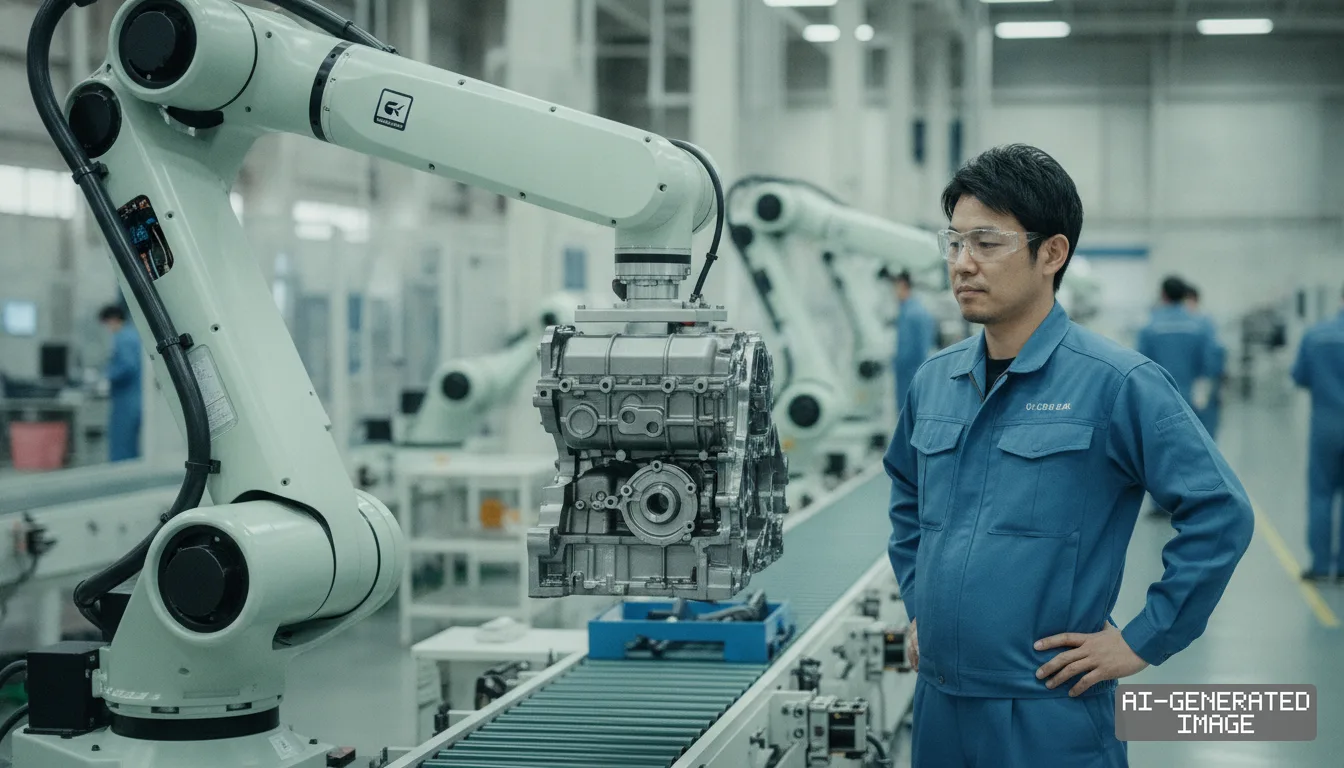
Fanuc Corporation and Teradyne subsidiary Universal Robots escalated competition for heavy-payload factory automation on Nov. 19, 2026, targeting assembly lines handling workpieces above 30 kilograms.
The shift into heavier payloads brings collaborative robots directly into workspaces historically reserved for guarded industrial arms. Collaborative robots operate alongside personnel without physical safety fences, using internal force limiters to prevent impact injuries.
Workcells handling parts over 30 kilograms represent a critical segment of automated palletizing, machine tending and heavy fastener assembly. Fanuc generated 44.1% of its consolidated net sales from its Robot Division in the fiscal year ended March 31, 2026.
Universal Robots pioneered commercial collaborative robots in 2008 and has delivered more than 110,000 units globally through parent Teradyne. The Danish arm manufacturer built its footprint on lightweight assembly, but manufacturing clients increasingly demand higher lifting capacities.
Factory operators are pushing for heavier payload robots to address worsening labor shortages across East Asia and North America. Moving heavy castings, battery modules and automotive stamping blanks requires payloads exceeding the traditional 10-to-20-kilogram threshold.
Fanuc meets this demand by scaling down structural techniques from its heavy industrial models. The Yamanashi-based robot builder sells the CR-35iB, which lifts up to 50 kilograms with a 1,643-millimeter reach, and the CRX-30iA, which carries 30 kilograms across 1,756 millimeters.
The CRX series uses high-rigidity cast structures and precision cycloidal reducers, paired with Fanuc's established industrial servomotors. Fanuc backs the line with an eight-year maintenance-free operational guarantee, targeted directly at Tier 1 automotive suppliers.
Universal Robots takes an architectural approach focused on joint electronics and dynamic software control. The Odense-based developer designed the UR30 around high-torque joint modules, offering a 30-kilogram standard payload with a 1,300-millimeter working reach.
The Danish cobot builder expanded the UR30 specification to 35 kilograms for downward-facing applications using its proprietary motion algorithm. That software update delivered additional lifting capacity to installed cells without requiring mechanical replacement.
The technological divergence creates two competing motion control standards on the factory floor. Fanuc relies on deterministic internal feedback loops tied to proprietary numerical controllers, while Universal Robots deploys open software interfaces through its PolyScope operating environment.
System integrators face distinct cost and integration trade-offs when selecting between the two designs. The Fanuc CRX arm weighs 145 kilograms to deliver mechanical stiffness, which limits its deployment on lightweight mobile bases.
The UR30 weighs 63.5 kilograms, allowing system integrators to mount the unit onto autonomous mobile platforms. However, lighter mechanical architectures experience greater joint deflection during high-speed acceleration when managing maximum inertia.
Industrial buyers in the automotive and metal fabrication sectors are watching motion repeatability closely. High-torque screwdriving and precise CNC machine loading require mechanical stability that tests the upper limits of joint-torque-sensing cobot arms.
Suppliers of precision robotic reducers, including Harmonic Drive Systems and Nabtesco, remain direct beneficiaries of this arms race. Heavy cobots require compact strain-wave and cycloidal gears that can withstand elevated moment loads during emergency stops.
Software standards also divide factory floor network architectures. Fanuc integrates cobots directly into its proprietary Field system, whereas Universal Robots relies on Ethernet-based fieldbus protocols and broad third-party end-effector ecosystems.
Neither company published a new joint declaration or unilateral product filing on Nov. 19, 2026, leaving exact weekly delivery numbers for 30-kilogram cobots unconfirmed. The commercial rivalry reflects ongoing procurement cycles across global automotive and general machinery plants.
Teradyne and Fanuc hold their next quarterly investor reviews in January 2027 to report full-year order backlogs across automotive and general industrial tooling.
## Impact map
| Event | Korea | China | Japan | Global impact |
| --- | --- | --- | --- | --- |
| Heavy cobot standard battle | Hyundai and battery cell lines evaluate 30kg cobots to replace dedicated caged cells | Domestic cobot builders scale up payloads, undercutting Japanese and Danish price points by 20% | Fanuc defends automotive dominance as gear suppliers Nabtesco and Harmonic Drive see higher spec orders | Machine shops reduce floor space by removing safety fences on heavy component assembly lines |
## In this story
- **Companies:** FANUC CORPORATION, Teradyne
- **Tickers:** 6954.T, TER
- **Exposed:** Harmonic Drive Systems, Nabtesco
- **Policy:** Standards
- **Impact:** Supply Chain, Order Book, Cost Structure
## Primary sources
1. fanuc.co.jp
2. universal-robots.com
3. robotzine.co.kr
---
Cite as: East Asia Brief, "Fanuc and Universal Robots compete for 30kg payload factory work," November 22, 2026. https://eastasiabrief.com/robotics/fanuc-universal-robots-compete-30kg-payload-factory-work-1679