# Doosan Robotics shifts cobot focus to auto and chip cleanrooms
*The Korean manufacturer targets a 46% revenue share from turnkey cells in 2026 to counter price cuts by Chinese rival Dobot Robotics.*
**Published:** November 7, 2026
**By:** Dae-hyun Kim
**Section:** Robotics & Automation — South Korea
**Format:** Company Watch
**Confidence:** medium
**Source:** https://eastasiabrief.com/robotics/doosan-robotics-shifts-cobot-focus-auto-chip-cleanrooms-1198
**Publisher:** East Asia Brief (https://eastasiabrief.com/)
---
## What to know
- Doosan Robotics targets 46% of 2026 revenue from turnkey automation cells
- Automotive supplier Kwangjin deploys over 100 cobots across 17 global sites by 2027
- Company holds institutional investor roadshow in Seoul on Nov. 10
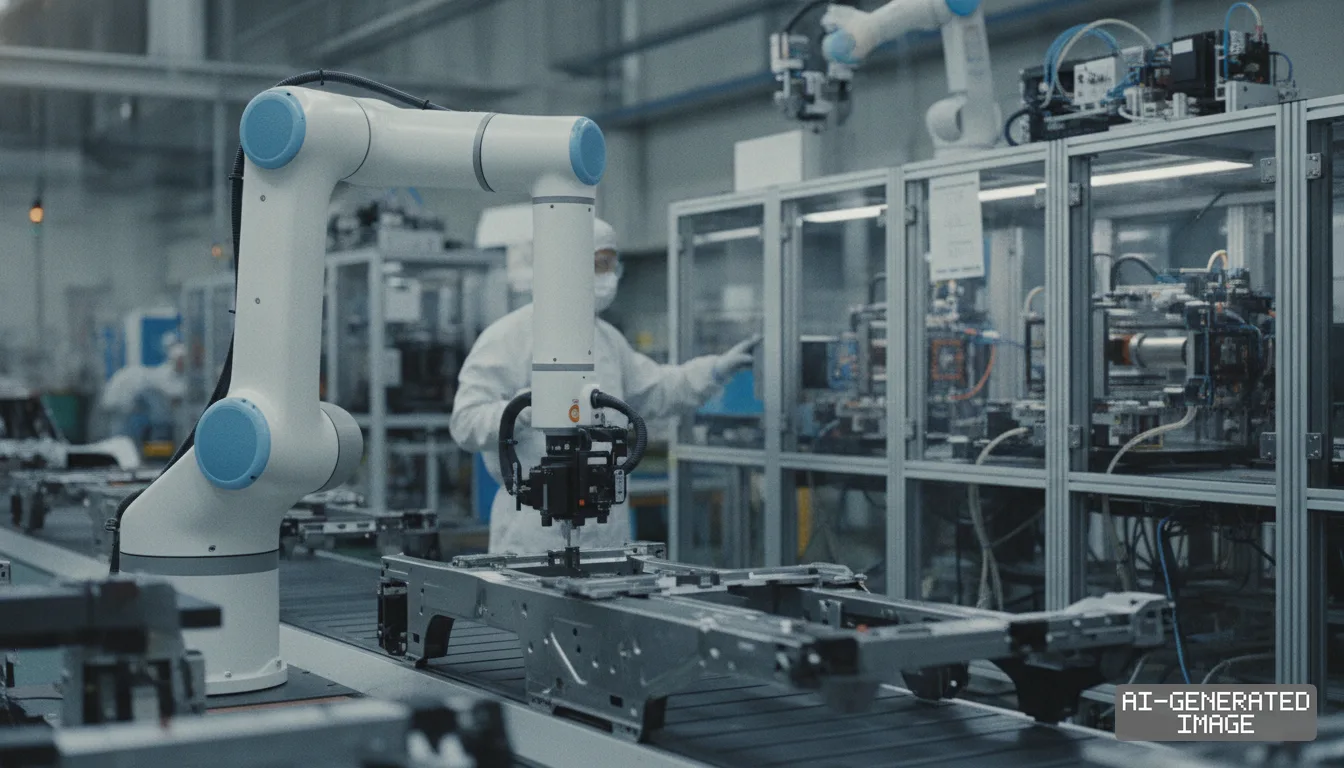
*A collaborative robot works on a metal automotive frame along an assembly line while a worker in protective gear stands in the background. (AI-generated image)*
Doosan Robotics accelerated a commercial pivot on Nov. 6, 2026, directing its collaborative robot deployments toward automotive plants and semiconductor cleanrooms to avoid escalating price competition from Chinese equipment makers.
The Suwon-based manufacturer is expanding turnkey automation systems to reach 46% of total revenue in 2026. That share stood at 22% during 2025, according to company earnings disclosures.
Turnkey systems package robotic arms with operating software and specialized end-effectors. Selling integrated cells yields wider operating margins than shipping standalone robot arms into commoditized commercial service sectors.
Chinese competitors led by Dobot Robotics have depressed robot hardware prices across East Asia. Dobot has shipped more than 100,000 collaborative arms worldwide by using lower domestic component costs and scale.
Price erosion in entry-level commercial cobots forced South Korean producers to change sales targets. Doosan Robotics executives signaled the shift during industrial briefings, prioritizing heavy-payload factory lines and semiconductor cleanrooms.
The company is concentrating commercial marketing on robotic arms capable of lifting 20 kilograms or more. Heavy lifting allows collaborative machines to handle bulky automotive assemblies alongside human workers without safety fences.
Automotive components supplier Kwangjin represents the largest public manufacturing deployment under this strategy. Kwangjin agreed to install more than 100 Doosan collaborative robots across 17 global manufacturing facilities.
A single collaborative robot in automotive component testing lifts plates and finished parts weighing up to 3.5 kilograms. The robot repeats that cycle roughly 4,000 times daily with constant positioning pressure.
Kwangjin plans to deploy the automated arms across parts plants in Poland and the United States through 2027. The supplier also intends to apply Doosan robots to all newly established American production lines.
Semiconductor cleanrooms demand strict particulate controls alongside microscopic positioning accuracy. Fabricators use specialized robotic arms to load silicon wafers into inspection chambers without exposing delicate wafers to airborne dust.
Cleanroom automation requires certified sealing materials and non-outgassing lubricants. Meeting cleanroom standards allows robot makers to charge premium equipment rates that low-cost hardware assemblers cannot match.
System integration in North America runs through subsidiary ONExia. Doosan Robotics doubled manufacturing capacity at the Pennsylvania integration unit to engineer bespoke automation cells for Western industrial buyers.
ONExia configures palletizing cells and machine-tending fixtures for American manufacturing clients. Adding engineering integration protects contract value when baseline hardware prices face downward pressure from Asian rivals.
At the Automate 2026 exhibition in Chicago, the company introduced PalletizHD+ for factory logistics. The system runs on proprietary PalletizOS software to combine artificial intelligence controls with palletizing hardware.
Software platforms also form a core element of the company's factory automation strategy. Doosan Robotics built the Dart-Suite operating system to help shop floors program robotic workflows without extensive coding.
The manufacturer also deployed Scan&Go, an automated mobile manipulator combining collaborative arms with autonomous transport. The mobile system executes six-degree-of-freedom navigation across shop floors without requiring computer-aided design blueprints.
State funding supports the company's push into high-precision industrial robotics. South Korea's Ministry of Trade, Industry and Energy awarded Doosan Robotics two national research projects in October.
The research consortium carries 98.9 billion won ($71 million) in total funding. The ministry committed 68.1 billion won of that budget to develop on-device artificial intelligence chips for collaborative robots.
A second state project funds robotic welding systems certified for nuclear power plant construction. Developing nuclear-grade welding tools positions the manufacturer to capture heavy-engineering contracts in domestic and export markets.
Parent company Doosan Corporation completed a separate investment on Nov. 6. Its Electro-Materials group committed 550 billion won ($395 million) to build copper-clad laminate lines in Changshu, China.
That Chinese laminate facility will produce materials for artificial intelligence accelerators starting in late 2028. The investment reflects broader group-level capital allocation toward advanced semiconductor hardware supply chains.
Regulatory filings do not confirm that Doosan Robotics has halted service robot shipments, and the company has published no statement mandating an exclusive fab transition.
Commercial service robots such as beverage-dispensing arms remain visible in existing retail customer installations. Company representatives described the automotive and cleanroom focus as a commercial realignment rather than an exit from service robotics.
Doosan Robotics will meet domestic institutional investors in Seoul on Nov. 10 for scheduled roadshow discussions, according to a Korea Exchange filing submitted by the company on Nov. 5.
## Impact map
| Event | Korea | China | Japan | Global impact |
| --- | --- | --- | --- | --- |
| Factory cobot realignment | Doosan Robotics lifts turnkey sales target to 46% of 2026 revenue | Dobot uses 100,000 unit volume to pressure entry hardware prices | Fanuc faces intensified competition in mid-tier automotive cobot cells | Kwangjin equips 17 international vehicle parts plants with Korean cobots by 2027 |
## In this story
- **Companies:** Doosan Robotics
- **Tickers:** 454910.KS
- **Exposed:** Kwangjin, Dobot Robotics
- **Policy:** Subsidies
- **Impact:** Order Book, Capex, Pricing
## Primary sources
1. seoulexchange.kr
2. stockinfo7.com
3. fetv.co.kr
4. creditnews.kr
5. ket.kr
---
Cite as: East Asia Brief, "Doosan Robotics shifts cobot focus to auto and chip cleanrooms," November 7, 2026. https://eastasiabrief.com/robotics/doosan-robotics-shifts-cobot-focus-auto-chip-cleanrooms-1198