# Doosan Robotics hires autonomous driving veteran as new CTO in AI push
*The South Korean cobot maker is shifting from arm hardware to an agentic operating system after securing $72 million in state physical AI research grants.*
**Published:** October 20, 2026
**By:** So-yeon Jung
**Section:** Robotics & Automation — South Korea
**Format:** Company Watch
**Confidence:** medium
**Source:** https://eastasiabrief.com/robotics/doosan-robotics-hires-autonomous-driving-veteran-new-cto-ai-823
**Publisher:** East Asia Brief (https://eastasiabrief.com/)
---
## What to know
- Doosan Robotics tapped autonomous driving head Woongjun Jang as CTO to build Agentic Robot OS
- Company won 68.1 billion won in state physical AI grants to automate nuclear welding and build on-device cobots
- First agentic OS solutions launch in 2027, followed by an industrial humanoid in 2028
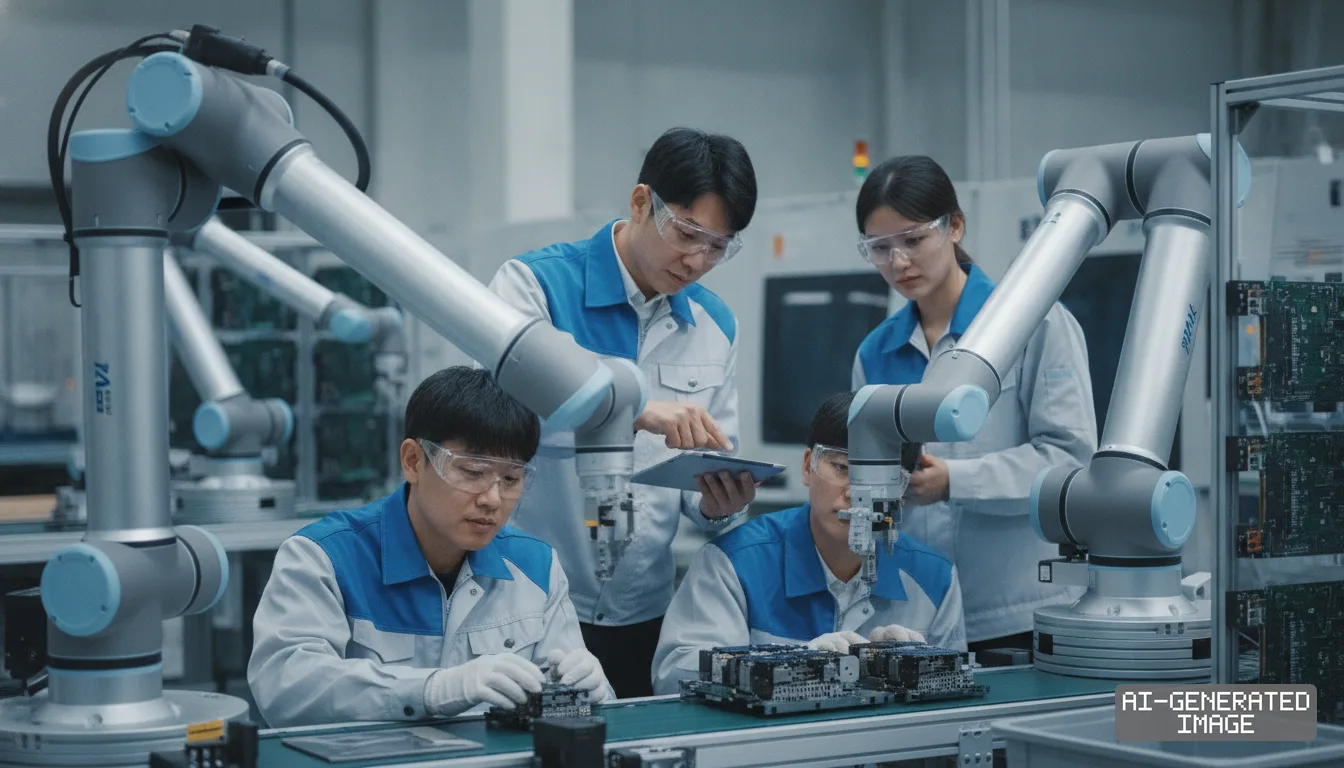
*Technicians work alongside collaborative robotic arms to assemble electronics on a factory production line. (AI-generated image)*
Doosan Robotics detailed a sweeping executive overhaul on Oct. 20, 2026, naming autonomous vehicle specialist Woongjun Jang as chief technology officer to direct its software and physical artificial intelligence expansion.
The Suwon-based manufacturer is South Korea's largest maker of collaborative robots — flexible mechanical arms that work safely alongside human laborers without safety cages.
The restructuring follows South Korea awarding the firm two physical AI contracts on Oct. 6 valued at 98.9 billion won ($71.5 million). State grants fund 68.1 billion won ($49.3 million), or 69% of the joint research budget.
Chief Executive Officer Young-min Kwon introduced the appointments at an internal town hall at the company's Bundang Innovation Center. Kwon took the top executive post on Sept. 18.
Jang previously directed autonomous driving software development at Hyundai Motor and served as chief strategy officer at Motional, the autonomous mobility venture between Hyundai and Aptiv. He joined Doosan Group in March.
The company also named Hyunsoo Kim as chief strategy officer to manage global key accounts and sales operations. Kim previously served as managing director for Doosan Bobcat in India.
Jang will lead the engineering of Agentic Robot OS, a proprietary software architecture that embeds spatial perception and path planning directly into robotic arms. Physical AI refers to algorithms that allow machines to sense, reason and act within dynamic industrial environments.
The operating system allows arms to alter motions autonomously using visual sensor streams rather than relying on external computers. Autonomous driving perception algorithms supply the core models for that spatial awareness, the company said.
Doosan Robotics is deepening its software integration with Nvidia to train and validate the operating system. The company uses Nvidia's Isaac Sim virtual simulation engine to run digital manipulation trials before deploying arms to factory floors.
Price erosion in standard robotic arms prompted the company's shift toward high-margin software solutions. Chinese hardware rivals have lowered mechanical arm export prices across Asian assembly lines by more than 20% over two years.
Commoditized hardware pricing has compounded persistent balance-sheet deficits for the Korean robot builder. Doosan Robotics has not recorded an annual operating profit since its establishment in 2015.
The company posted an operating loss of 59.5 billion won ($43.1 million) in 2025. That deficit exceeded its entire full-year revenue of 33 billion won ($23.9 million).
First-half 2026 revenue reached 32.97 billion won ($23.8 million), rising 236% from the prior year following the consolidation of US automation integrator ONExia. First-half operating losses still totaled 26.49 billion won ($19.2 million).
The primary state-funded initiative focuses on building collaborative robots powered by domestic neural processing units, which are microchips specialized for on-device machine learning calculations. The project runs for 54 months.
Engineers will embed the domestic processors into three payload models rated for five, 10 and 20 kilograms. On-device computing eliminates cloud transmission latency and factory data-security concerns, the company said.
The underlying processor architecture will also power an industrial humanoid robot. Doosan Robotics plans to equip that machine with dual working arms and omnidirectional mobile wheels for plant logistics.
The second state-backed program targets precision welding automation using digital twin software. Digital twins create synchronized virtual simulations of physical assembly cells to track torch movements in real time.
The software aims to match veteran welders' weaving paths with 95% accuracy while keeping spatial deviation within 3 millimeters. Automating complex multilayer welds will reduce fabrication time by over 50%, the company said.
Heavy equipment manufacturer Doosan Enerbility will host factory trials for the automated welding platform at its Nuclear Power Center. The company plans to deploy the robotic welders on nuclear reactor components before expanding to shipyards and defense plants.
Global cobot leader Universal Robots, owned by US-based Teradyne, maintains roughly a third of worldwide collaborative robot sales. Integrating autonomous vision software is designed to counter Teradyne's installed base in Western factories.
Doosan Robotics scheduled commercial availability of its Agentic Robot OS solutions for 2027. The manufacturer aims to commercialize its dual-arm industrial humanoid robot for heavy fabrication plants by 2028.
Commercialization of the government-backed on-device AI cobot models is slated for 2031 following international safety certifications. Factory demonstrations across domestic suppliers will begin in 2029.
Doosan Robotics did not submit executive appointment filings to the Financial Supervisory Service, leaving the contractual duration and specific compensation packages for the new leadership unpublished.
## Impact map
| Event | Korea | China | Japan | Global impact |
| --- | --- | --- | --- | --- |
| Doosan Robotics software pivot | Doosan Enerbility cuts nuclear welding cycle times by 50% using robotic arms | Chinese cobot builders maintain 20% hardware price discounts across Asian assembly lines | Fanuc faces intensified competition in high-payload intelligent assembly cells | Nvidia expands industrial software reach through Isaac Sim integration in Korean factories |
## In this story
- **Companies:** Doosan Robotics
- **Tickers:** 454910.KS
- **Exposed:** Doosan Enerbility, Nvidia
- **Policy:** Subsidies
- **Impact:** Capex, Cost Structure, Pricing
## Primary sources
1. doosanrobotics.com
2. heraldk.com
3. greened.kr
4. yonhapnewstv.co.kr
5. fnnews.com
---
Cite as: East Asia Brief, "Doosan Robotics hires autonomous driving veteran as new CTO in AI push," October 20, 2026. https://eastasiabrief.com/robotics/doosan-robotics-hires-autonomous-driving-veteran-new-cto-ai-823