# LG Energy Solution validates cobalt-free LMR battery cells
*A joint study with Seoul National University demonstrates 92.2% energy retention over 883 cycles in 40-ampere-hour pouch cells by narrowing operating voltage windows.*
**Published:** September 17, 2026
**By:** Seung-min Park
**Section:** Batteries & Electric Vehicles — South Korea
**Format:** Why It Matters
**Confidence:** medium
**Source:** https://eastasiabrief.com/batteries-ev/lg-energy-solution-validates-cobalt-free-lmr-battery-cells-302
**Publisher:** East Asia Brief (https://eastasiabrief.com/)
---
## What to know
- LG Energy Solution and Seoul National University achieved 92.2% retention after 883 cycles in 40Ah LMR cells
- Lowering upper charging cutoff to 4.3V raised oxygen reduction rate from 86% to 97% to curb gas evolution
- LG Energy Solution reports Q3 2026 results in late October, while commercial production schedules remain unannounced
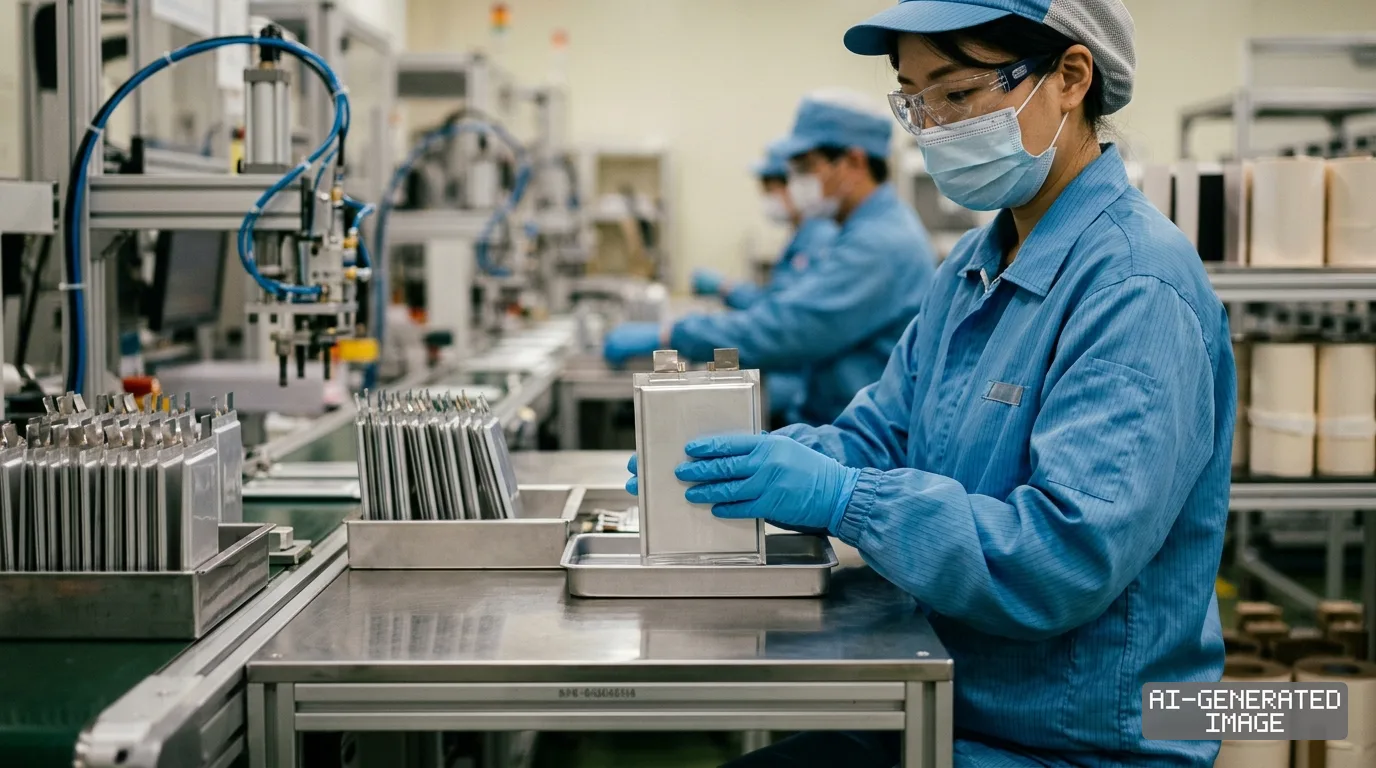
*Factory workers wearing masks and protective gear handle battery cells along an industrial assembly line. (AI-generated image)*
LG Energy Solution confirmed on Sept. 17 that its joint research team with Seoul National University demonstrated a 92.2% energy retention rate over 883 cycles for cobalt-free lithium manganese-rich battery cells.
The South Korean battery maker operates more than 200 gigawatt-hours of global manufacturing capacity. The company supplies pouch and cylindrical cells to major automakers across North America, Europe and East Asia.
The research evaluated 40-ampere-hour large-format pouch cells, a size intended for passenger electric vehicles. The 92.2% capacity retention after 883 charging cycles represents a technical benchmark for manganese-dominant cathode chemistries.
Lithium manganese-rich cells replace expensive cobalt and reduce high nickel content by using abundant manganese as the primary cathode constituent. The design cuts raw material expense while preserving energy storage capacity.
The chemistry relies on both transition metals and lattice oxygen — the oxygen atoms integrated into the cathode crystal structure — to store electrical charge. That dual mechanism delivers higher theoretical energy density than conventional formulations.
Commercial adoption had stalled because oxidized oxygen fails to return fully to its initial state during repeated discharge cycles. The resulting structural instability generates internal gas that swells sealed automotive pouches.
The joint research team altered the operating voltage parameters to maintain cathode stability. Lowering the upper charging limit from 4.6 volts to 4.3 volts prevented excessive lattice degradation, the researchers said.
That voltage adjustment increased the reduction rate of oxidized oxygen from 86% to 97%. Raising oxygen reversibility prevented destructive crystal reorganization during continuous vehicle operation, according to the research findings.
The researchers also widened the lower discharge cutoff from 3.0 volts down to 2.0 volts. The wider discharge window enabled evacuated lithium ions to re-enter the host framework and restore lattice oxygen bonds.
Formation processing received operational revisions as well. The engineering team reduced temperatures during the initial formation stage — the first controlled charging step in factory cell assembly — to suppress chemical gas evolution.
Previous laboratory tests evaluated manganese-rich chemistries only in coin cells holding fractions of an ampere-hour. Validating the process in 40-ampere-hour pouch units proves mechanical feasibility under genuine automotive operating pressures.
Automakers have sought lower-cost alternatives to nickel-cobalt-manganese cells as consumer demand shifts toward entry-level electric models. High-nickel cathodes carry substantial raw material costs tied to volatile refined nickel and cobalt markets.
Chinese manufacturers have capitalized on that cost sensitivity through lithium iron phosphate chemistry. Contemporary Amperex Technology and BYD together control more than 60% of the worldwide electric vehicle battery market, largely through iron-based cells.
Lithium iron phosphate packs offer low production costs and thermal stability but suffer from limited volumetric energy density. Manganese-rich cathodes deliver roughly 33% higher energy density than standard iron-phosphate formulations, according to industry data.
That energy margin allows automakers to extend driving range without increasing pack physical volume. Removing cobalt entirely also simplifies mineral supply chains subject to stringent labor and environmental tracing standards in Western jurisdictions.
South Korea's three major battery producers have sought chemical pathways to match Chinese manufacturing pricing. Developing commercial manganese-rich formulations allows domestic factories to defend market share in mainstream vehicle segments across the United States and Europe.
The voltage and thermal modifications require no fundamental changes to standard cell packaging machinery. LG Energy Solution can integrate the updated formation temperatures and cycling profiles into existing pouch manufacturing plants without major equipment write-offs.
The findings appeared in the peer-reviewed scientific journal Nature Communications following review by international electrochemistry specialists. Seoul National University chemistry professor Jongwoo Lim led the academic research team alongside company engineers.
The company has not published commercial production targets, mass-production capital expenditure figures, or initial customer supply agreements for the LMR cells. Automotive qualification timelines typically require several additional years of rigorous road testing.
LG Energy Solution reports third-quarter financial results in late October 2026. Management is scheduled to update analysts then on capital spending allocations for alternative cell chemistries.
## Impact map
| Event | Korea | China | Japan | Global impact |
| --- | --- | --- | --- | --- |
| LMR cell validation | LG Energy Solution tests 40Ah pouch chemistry to replace cobalt and reduce nickel reliance | CATL and BYD face direct mid-tier competition against their 60% combined EV battery share | Panasonic remains committed to high-nickel cylindrical lines without an announced LMR timetable | Automakers gain cathode chemistry offering roughly 33% higher energy density than lithium iron phosphate |
## In this story
- **Companies:** LG Energy Solution
- **Tickers:** 373220.KS
- **Exposed:** Contemporary Amperex Technology, BYD, General Motors
- **Policy:** Economic Security, Subsidies
- **Impact:** Cost Structure, Supply Chain, Capex
## Primary sources
1. lgensol.com
2. snu.ac.kr
3. mk.co.kr
4. danawa.com
5. notebookcheck.net
---
Cite as: East Asia Brief, "LG Energy Solution validates cobalt-free LMR battery cells," September 17, 2026. https://eastasiabrief.com/batteries-ev/lg-energy-solution-validates-cobalt-free-lmr-battery-cells-302