# LG Energy Solution curbs gas in LMR cells for 2028 vehicles
*Tests on 40-ampere-hour vehicle cells showed 92.2% energy retention after 883 cycles by adjusting operating voltages and lowering formation temperatures.*
**Published:** September 7, 2026
**By:** Seung-min Park
**Section:** Batteries & Electric Vehicles — South Korea
**Format:** Breaking
**Confidence:** medium
**Source:** https://eastasiabrief.com/batteries-ev/lg-energy-solution-curbs-gas-lmr-cells-2028-vehicles-203
**Publisher:** East Asia Brief (https://eastasiabrief.com/)
---
## What to know
- The South Korean battery manufacturer conducted the research with a team led by chemistry professor Jongwoo Lim at Seoul National University.
- Lithium manganese-rich chemistry, known as LMR, eliminates costly cobalt from the cathode while lowering nickel content.
- Standard cathode materials store energy exclusively through transition metals like nickel, cobalt and manganese.
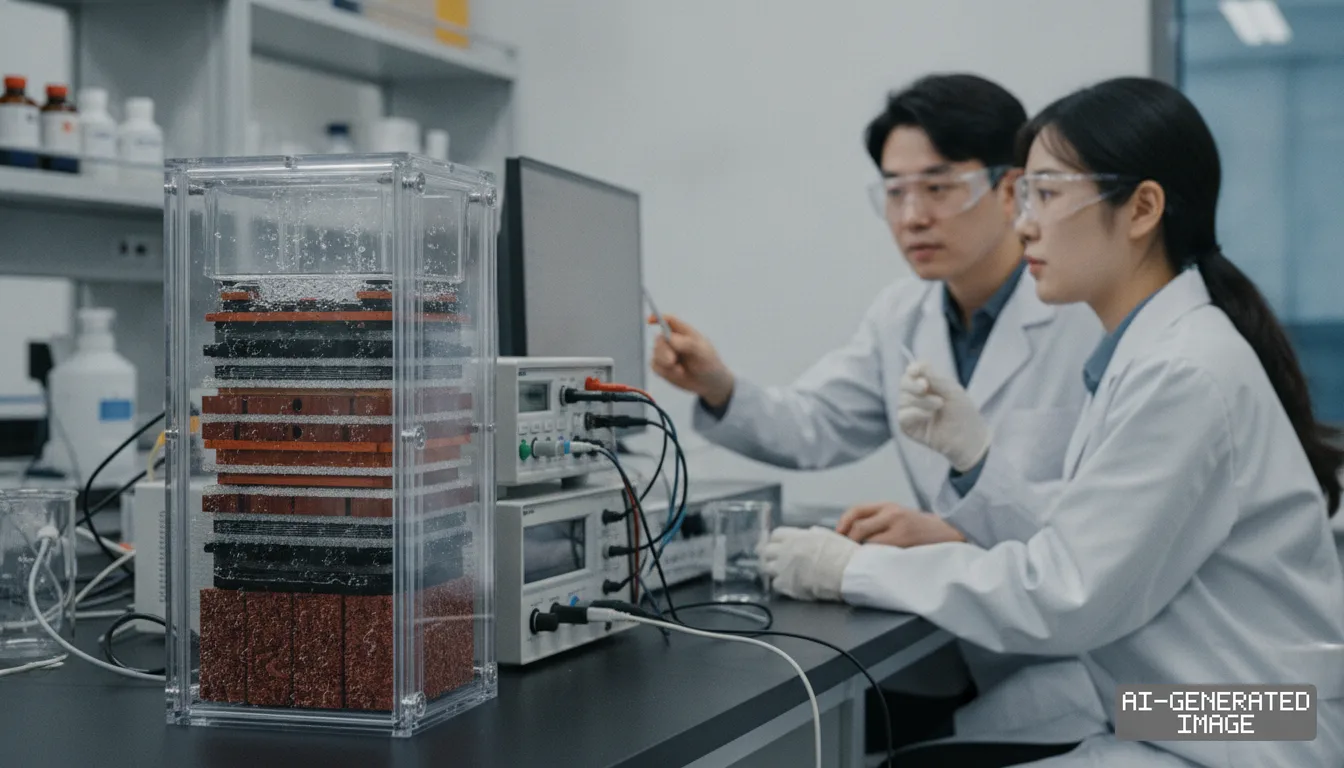
*Two researchers in lab coats examine testing equipment connected to an electrochemical cell in a laboratory. (AI-generated image)*
LG Energy Solution said Sept. 7 that it developed an electrochemical operating method to halt gas generation in lithium manganese-rich batteries, advancing large-format automotive cells toward commercial deployment.
The South Korean battery manufacturer conducted the research with a team led by chemistry professor Jongwoo Lim at Seoul National University. The peer-reviewed journal Nature Communications published the findings on the same day.
Lithium manganese-rich chemistry, known as LMR, eliminates costly cobalt from the cathode while lowering nickel content. The formulation relies instead on low-cost manganese and oxygen reactions inside the crystal lattice to store electrical energy.
Standard cathode materials store energy exclusively through transition metals like nickel, cobalt and manganese. LMR cathodes add an oxygen redox mechanism, an electron-exchange reaction inside the cathode lattice that boosts total energy storage capacity.
That oxygen mechanism previously stalled commercial development because oxidized oxygen failed to return to its original state during discharge cycles. Incomplete oxygen recovery triggered structural damage and released pressurized gas inside the sealed cell.
Small coin-style laboratory cells tolerated gas buildup because of their low volume. In 40-ampere-hour vehicle cells with tightly packed internal components, accumulated gas increased internal pressure and caused pouch expansion that reduced cycle life.
Researchers analyzed oxygen behavior across varying electrical ranges to fix the problem without redesigning the cathode material. The team discovered that changing voltage limits restored oxygen reversibility during repetitive cycling.
Lowering the upper charging voltage from 4.6 volts to 4.3 volts raised the reduction rate of oxidized oxygen from 86% to 97%, the study said. The lower ceiling prevented oxygen atoms from breaking structural bonds to form free gas.
The team also widened the lower discharge boundary from 3.0 volts down to 2.0 volts. That expanded voltage window supplied the necessary electrical force to return oxidized oxygen back to its original lattice positions.
Engineers altered factory processing conditions alongside operating voltages. Lowering the temperature during cell formation, the initial factory charging step that conditions fresh electrodes, suppressed gas release before final packaging.
The combined operational protocol was tested on full-size 40-ampere-hour cells built to automotive standards. The test cells retained 92.2% of their initial energy capacity after 883 continuous charge and discharge cycles.
Cell stability can improve through electrochemical operating design alone without costly cathode coatings or additives, Lim said in the statement. The test demonstrated that large automotive cells maintain structural integrity under adjusted voltage thresholds.
The company had previously displayed a prototype LMR battery cell at the InterBattery 2026 trade exhibition in Seoul. The new laboratory validation provides operational parameters needed to scale those prototype cells into production lines.
LG Energy Solution plans to begin mass production of LMR batteries in 2028, the company said. The chemistry serves as an intermediate option between entry-level lithium iron phosphate and premium high-nickel formulations.
The technical validation aligns with a joint development agreement signed with General Motors in May 2025. The two companies partnered to develop prismatic LMR battery cells for electric pickup trucks and large sport utility vehicles.
The planned cells adopt a rigid prismatic casing rather than a flexible pouch. Switching to the prismatic form factor reduces the total part count in a battery pack by more than 50%, GM said.
Ultium Cells, the manufacturing joint venture operated by GM and LG Energy Solution, plans to start pre-production at an LG Energy Solution site in late 2027. Commercial production in the United States is scheduled for 2028.
The prismatic LMR cells deliver 33% higher energy density than premium lithium iron phosphate cells at comparable cost, GM said in its 2025 development announcement. The chemistry aims to deliver vehicle driving ranges exceeding 400 miles.
Adopting manganese-rich chemistry could lower the cost of an electric truck pack by roughly $6,000 compared to high-nickel packs, GM engineers estimated in project disclosures. That cost differential helps automakers reach parity with gasoline vehicles.
Global carmakers require lower-cost batteries to expand vehicle sales across North America and Europe. Chinese manufacturers currently dominate the supply of low-cost lithium iron phosphate cells, producing more than 80% of global output.
South Korean battery makers previously concentrated on high-nickel chemistries that deliver long range but require volatile cobalt supplies. LG Energy Solution is developing LMR lines alongside iron-phosphate cells to offer automakers alternatives to Chinese supply chains.
Engineers will carry out final design validation at GM's Battery Cell Development Center in Warren, Michigan, and at LG Energy Solution development facilities in South Korea before pilot production begins in 2027.
## Impact map
| Event | Korea | China | Japan | Global impact |
| --- | --- | --- | --- | --- |
| LMR battery gas suppression | cell manufacturing scale | LFP price rivalry | separator demand | mass-market EV pricing |
## In this story
- **Companies:** LG Energy Solution
- **Tickers:** 373220.KS
- **Exposed:** General Motors, Ultium Cells
- **Policy:** Subsidies
- **Impact:** Supply Chain, Cost Structure, Capex
## Primary sources
1. lgensol.com
2. donga.com
3. daum.net
4. m-i.kr
5. hankyung.com
---
Cite as: East Asia Brief, "LG Energy Solution curbs gas in LMR cells for 2028 vehicles," September 7, 2026. https://eastasiabrief.com/batteries-ev/lg-energy-solution-curbs-gas-lmr-cells-2028-vehicles-203