# Korean battery makers lose market share as Chinese LFP cells surge
*Combined volume for LG Energy Solution, SK On and Samsung SDI fell 12.8% outside China despite a 23.7% rebound in non-domestic electric vehicle battery installations.*
**Published:** October 25, 2026
**By:** Seung-min Park
**Section:** Batteries & Electric Vehicles — South Korea
**Format:** Why It Matters
**Confidence:** medium
**Source:** https://eastasiabrief.com/batteries-ev/korean-battery-makers-lose-market-share-chinese-lfp-cells-926
**Publisher:** East Asia Brief (https://eastasiabrief.com/)
---
## What to know
- Korean trio saw combined global market share slide 3.9 points to 12.7%
- Non-China battery demand rose 23.7% to 360.5 GWh as Korean volume fell 12.8%
- Samsung SDI reports third-quarter performance on Oct. 29, 2026
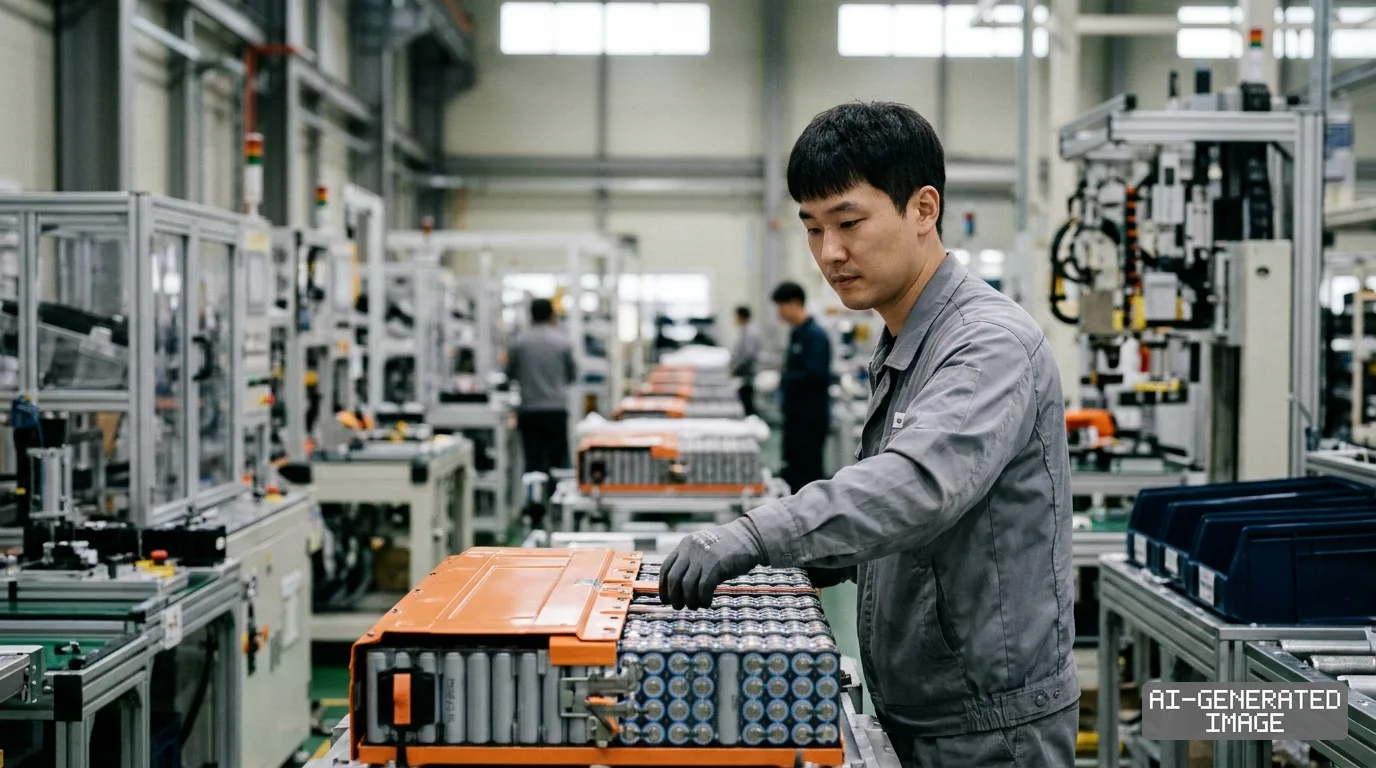
*A factory worker inspects an electric vehicle battery pack along an assembly line inside a manufacturing plant. (AI-generated image)*
SNE Research reported Oct. 25, 2026, that South Korea's three primary battery manufacturers lost market share across global electric vehicle markets, as Chinese cell producers dominated rebounding demand with cheaper chemistry.
Worldwide electric vehicle battery installations expanded 19.7% year-on-year to 844.2 gigawatt-hours between January and August 2026. The surge reflects accelerating adoption across passenger and commercial fleets in Europe and Asia.
Combined global market share for LG Energy Solution, SK On and Samsung SDI shrank by 3.9 percentage points to 12.7% during the eight-month period. Chinese manufacturers expanded their collective share to 73.3%.
Outside mainland China, overall battery installations grew 23.7% to 360.5 gigawatt-hours. South Korean suppliers failed to capture that expansion, recording a 12.8% contraction in delivered energy to 96.5 gigawatt-hours.
The South Korean trio's share of non-Chinese markets dropped 11.1 percentage points from 37.9% to 26.8%. Chinese competitors captured the balance by expanding sales to international automotive groups.
Contemporary Amperex Technology Co. Limited, known as CATL, consolidated its lead by deploying 333.0 gigawatt-hours globally, a 25.2% increase. That performance lifted CATL's worldwide market share to 39.4%.
BYD Company delivered 127.9 gigawatt-hours over the same period, posting 6.2% growth. Together, CATL and BYD commanded 54.6% of all battery capacity deployed in registered electric vehicles worldwide.
LG Energy Solution held third place globally with 68.3 gigawatt-hours, rising just 0.9% year-on-year. Slower delivery growth reduced the manufacturer's global market share by 1.5 percentage points to 8.1%.
The company's North American installations fell 42.3% from 25.2 gigawatt-hours to 14.6 gigawatt-hours. Gains across European and Asian customer programs were insufficient to offset the sharp North American downturn.
SK On ranked eighth globally, delivering 24.9 gigawatt-hours, a 14.5% year-on-year drop. The company's global share slipped from 4.1% to 2.9% as factory utilization adjusted downward.
Deliveries from SK On to North American assembly lines tumbled 41.8% to 6.8 gigawatt-hours. The decline followed slower production runs by key automotive partners, including Ford Motor and Volkswagen.
Samsung SDI recorded the steepest contraction among South Korean cell makers, with non-Chinese deployments falling 32%. Lower volumes from clients such as Rivian Automotive reduced Samsung SDI's non-Chinese share to 3.8%.
The divergence stems from a widening structural shift in battery chemistry toward lithium iron phosphate cells. Automakers increasingly select the iron-based chemistry over nickel-rich formulations to lower entry-level vehicle prices.
Lithium iron phosphate accounted for 65.4% of total cathode material capacity deployed globally through August, up 5.0 percentage points. The chemistry delivers lower energy density than nickel alternatives at substantially lower manufacturing cost.
Adoption of iron-based packs outside China surged, rising from 20.8% of deployed battery volume to 34.9%. Chinese cell producers supply almost the entire non-Chinese volume of these standardized packs.
South Korean battery makers concentrated their capital expenditure on nickel-cobalt-manganese cells designed for premium models. That capital commitment left their production networks poorly aligned with the recovery in budget electric cars.
Pure battery electric vehicle registrations jumped 45% in the European Union to 1.64 million units through August. Emerging Asian markets recorded a 77% surge in non-Chinese electric vehicle registrations over the same timeframe.
European and Asian automotive manufacturers sourced cheaper packs directly from Chinese factories to support budget models. Chinese producers also established regional distribution hubs, bypassing logistics delays and blunting trade restrictions.
South Korean manufacturers have relied heavily on tax credits provided under the United States Inflation Reduction Act. However, softer United States retail demand left high-nickel joint-venture plants operating well below design capacity.
Total battery installations across North America dropped 46.5% during the period, falling from 47.4 gigawatt-hours to 25.3 gigawatt-hours. That contraction disproportionately hit South Korean cell makers with dedicated regional plants.
LG Energy Solution and SK On have begun retooling selected production lines to assemble lithium iron phosphate products. Commercial deliveries of automotive iron-based packs from these plants will not begin until mid-2027.
Domestic cell producers have cushioned automotive revenue declines by shifting cell lines to utility-scale energy storage systems. Demand from cloud data center operators supported short-term third-quarter operating margins across the group.
Analysts caution that stationary storage contracts represent lower unit margins than premium automotive pack supply agreements. Revenue stabilization in storage fails to resolve long-term automotive manufacturing overcapacity in North America.
The tracking data do not state whether European tariffs enacted in July altered Chinese export pricing, and SNE Research has not published automaker-specific inventory figures.
Samsung SDI will publish detailed third-quarter operational metrics on Oct. 29, 2026. Automakers and component suppliers will review joint-venture production targets during regular board sessions scheduled throughout November.
## Impact map
| Event | Korea | China | Japan | Global impact |
| --- | --- | --- | --- | --- |
| Chinese LFP surge | Korean trio share outside China drops 11.1 points to 26.8% | CATL expands global share to 39.4% on overseas LFP supply | Panasonic gains 4% to 9.1 GWh on North American Tesla lines | Automakers accelerate shift to LFP to cut entry-level EV pack costs |
## In this story
- **Companies:** LG Energy Solution, SK On, Samsung SDI, Contemporary Amperex Technology
- **Tickers:** 373220.KS, 006400.KS, 300750.SZ
- **Exposed:** Ford Motor, BYD
- **Policy:** Subsidies, Tariffs
- **Impact:** Pricing, Capex, Supply Chain
## Primary sources
1. chosun.com
2. sneresearch.com
3. edaily.co.kr
4. battery-tech.net
5. businesskorea.co.kr
---
Cite as: East Asia Brief, "Korean battery makers lose market share as Chinese LFP cells surge," October 25, 2026. https://eastasiabrief.com/batteries-ev/korean-battery-makers-lose-market-share-chinese-lfp-cells-926