# CATL warns EV price war compromises battery safety standards
*Chairman Robin Zeng cautions that compressed testing cycles and cutthroat discounting in China are triggering batch failures across mass-market battery packs.*
**Published:** October 18, 2026
**By:** Lian Chen
**Section:** Batteries & Electric Vehicles — China
**Format:** Breaking
**Confidence:** medium
**Source:** https://eastasiabrief.com/batteries-ev/catl-warns-ev-price-war-compromises-battery-safety-standards-792
**Publisher:** East Asia Brief (https://eastasiabrief.com/)
---
## What to know
- CATL Chairman Robin Zeng warned on Oct. 16, 2026, that EV price wars trigger batch battery failures
- Cell prices fell below 0.35 yuan per watt-hour as brands launched over 600 models in 2026
- China's industry ministry reviews mandatory vehicle testing rules in Beijing in November 2026
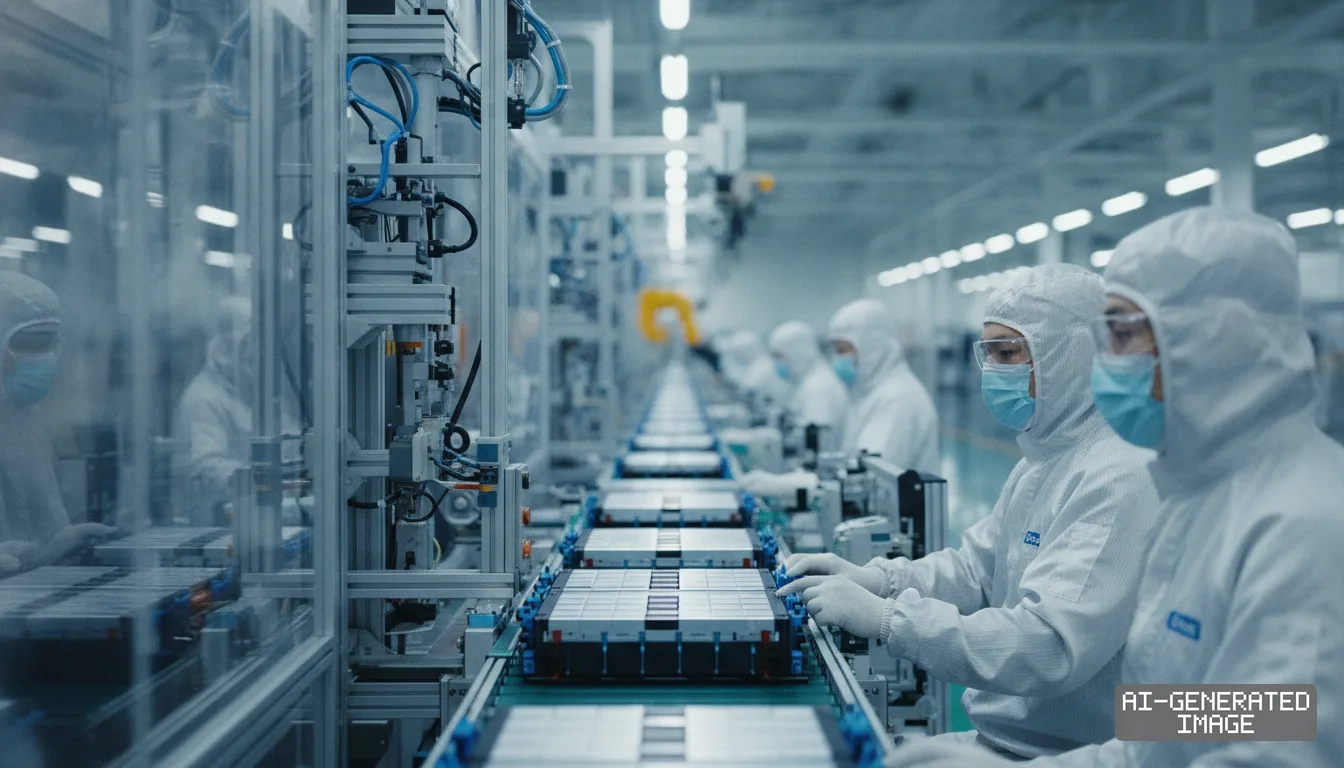
*Workers in protective suits assemble electric vehicle battery modules along an automated factory production line. (AI-generated image)*
Contemporary Amperex Technology Chairman Robin Zeng warned on Oct. 16, 2026, that relentless price-cutting across China's electric vehicle market is compressing validation schedules and triggering batch-level battery quality failures.
The Fujian-based manufacturer, known as CATL, accounts for more than 37% of the global electric vehicle battery market. Zeng made the remarks as carmakers accelerate model rollouts to survive margin erosion.
China's new energy vehicle sales surpassed 7.4 million units in the first half of the year, capturing nearly 50% of domestic passenger car deliveries. Global power battery installations reached 608 gigawatt-hours in the same period.
Chinese battery manufacturers hold seven of the top 10 global capacity rankings, controlling more than 70% of worldwide supply. Yet extreme discounting has pushed lithium iron phosphate cell prices below 0.35 yuan ($0.049) per watt-hour.
Domestic automakers have introduced more than 600 new vehicle models this year, averaging nearly three releases per day. Zeng warned that commercial rivalry has shifted from technical innovation to unsustainable speed and predatory pricing.
Automakers are cutting vehicle development cycles from traditional four-year timelines to less than 18 months. Shortened durability testing leaves suppliers unable to conduct full thermal stress and aging validation, Zeng said.
The compressed verification window has resulted in severe defects across entire production batches, Zeng said. Such systematic flaws elevate the risk of vehicle fires and undermine consumer confidence across the wider automotive sector.
A single battery pack connects hundreds of individual cells in series and parallel. A defect in one component undermines the thermal stability and impedance of the entire pack, creating severe safety risks during high-power charging.
Automotive components traditionally operate under a Six Sigma standard of parts per million, which tolerates several defective units per million items. Zeng argued that explosive production volumes make that threshold dangerously obsolete.
With more than 30 million electric vehicles using CATL cells globally, a parts-per-million standard permits thousands of defective packs on public roads. Cell production requires parts-per-billion reliability, meaning fewer than one defect per billion units, Zeng said.
The warning lands directly on mass-market automakers like BYD and emerging pure-play brands that rely on price cuts. BYD produces its own lithium iron phosphate blade cells and prices compact electric cars below 75,000 yuan ($10,500).
Tier-two cell makers, including CALB and Gotion High-tech, operate at lower operating margins than CATL. These manufacturers face intense commercial pressure from automakers to match price reductions on multi-year supply contracts.
Automakers regularly demand double-digit price concessions during annual contract renewals. When cell makers exhaust manufacturing efficiencies, cost cuts inevitably reach cathode specifications, separator thickness and pack insulation layers, engineers said.
Reducing separator thickness lowers manufacturing costs and marginally boosts energy density, but it narrows the physical barrier between electrodes. Thinner membranes increase the probability of internal short circuits under mechanical vibration or dendrite growth.
CATL maintains an internal standard centered on safety, operating life and defect suppression through automated inspection. The company invested 18.4 billion yuan ($2.59 billion) in annual research and development to build proprietary artificial-intelligence production controls.
Smaller competitors cannot sustain comparable research expenditures while selling cells below cash production costs. Several secondary cell producers ran factory capacity utilization below 55% during the second quarter, industry filings showed.
Zeng cautioned that homogeneous price competition damages the industry's international expansion. Foreign regulators in Europe and North America are expanding compliance scrutiny over manufacturing safety, battery passports and supply chain traceability.
European Union rules requiring digital battery passports and life-cycle carbon footprint declarations take effect across member states in 2027. Substandard cells exported in finished vehicles risk triggering costly product recalls and regulatory bans abroad.
The warning also carries implications for the stationary energy storage sector, where battery installations operate under continuous electrical load. Defective cells in grid-scale battery parks multiply fire hazards in densely populated industrial corridors.
China's Ministry of Industry and Information Technology has scheduled a review of vehicle validation cycles and defect reporting rules for November 2026. The agency plans to mandate longer minimum testing periods for traction batteries.
The public notices do not identify the specific vehicle models or manufacturing batches that suffered failures. Regulators have not published the inspection reports detailing defect rates among individual cell suppliers.
CATL shares closed down 0.8% at 248.50 yuan in Shenzhen trading on Friday, while the benchmark ChiNext Index slipped 0.4%.
## Impact map
| Event | Korea | China | Japan | Global impact |
| --- | --- | --- | --- | --- |
| EV battery price war and quality defect warning | LG Energy Solution and Samsung SDI gain validation leverage over Chinese tier-two pricing pressure | BYD and mid-tier cell makers face margin squeeze under impending state durability mandates | Panasonic Energy sees safety differentiation demand rise among multinational automotive clients | Western EV procurement desks review tier-one cell failure rates as LFP battery prices break $50/kWh |
## In this story
- **Companies:** Contemporary Amperex Technology
- **Tickers:** 300750.SZ
- **Exposed:** BYD, CALB, Gotion High-tech
- **Policy:** Standards
- **Impact:** Pricing, Cost Structure, Compliance
## Primary sources
1. carnewschina.com
2. ventureatlas.org
3. catl.com
4. starnewskorea.com
5. udn.com
---
Cite as: East Asia Brief, "CATL warns EV price war compromises battery safety standards," October 18, 2026. https://eastasiabrief.com/batteries-ev/catl-warns-ev-price-war-compromises-battery-safety-standards-792