# CATL launches TECTRANS II battery to anchor European trucks
*The modular commercial platform delivers a 1,000-kilometer range and cuts automaker research costs up to 70%, backed by a green corridor pact with DHL Group.*
**Published:** September 27, 2026
**By:** Lian Chen
**Section:** Batteries & Electric Vehicles — China
**Format:** Breaking
**Confidence:** medium
**Source:** https://eastasiabrief.com/batteries-ev/catl-launches-tectrans-ii-battery-anchor-european-trucks-396
**Publisher:** East Asia Brief (https://eastasiabrief.com/)
---
## What to know
- TECTRANS II platform delivers a 1,000-kilometer range and cuts automaker R&D costs up to 70%
- CATL held roughly 44% of global electric vehicle battery shipments in the first half of 2026
- Pilot deployments across European freight corridors begin in early 2027
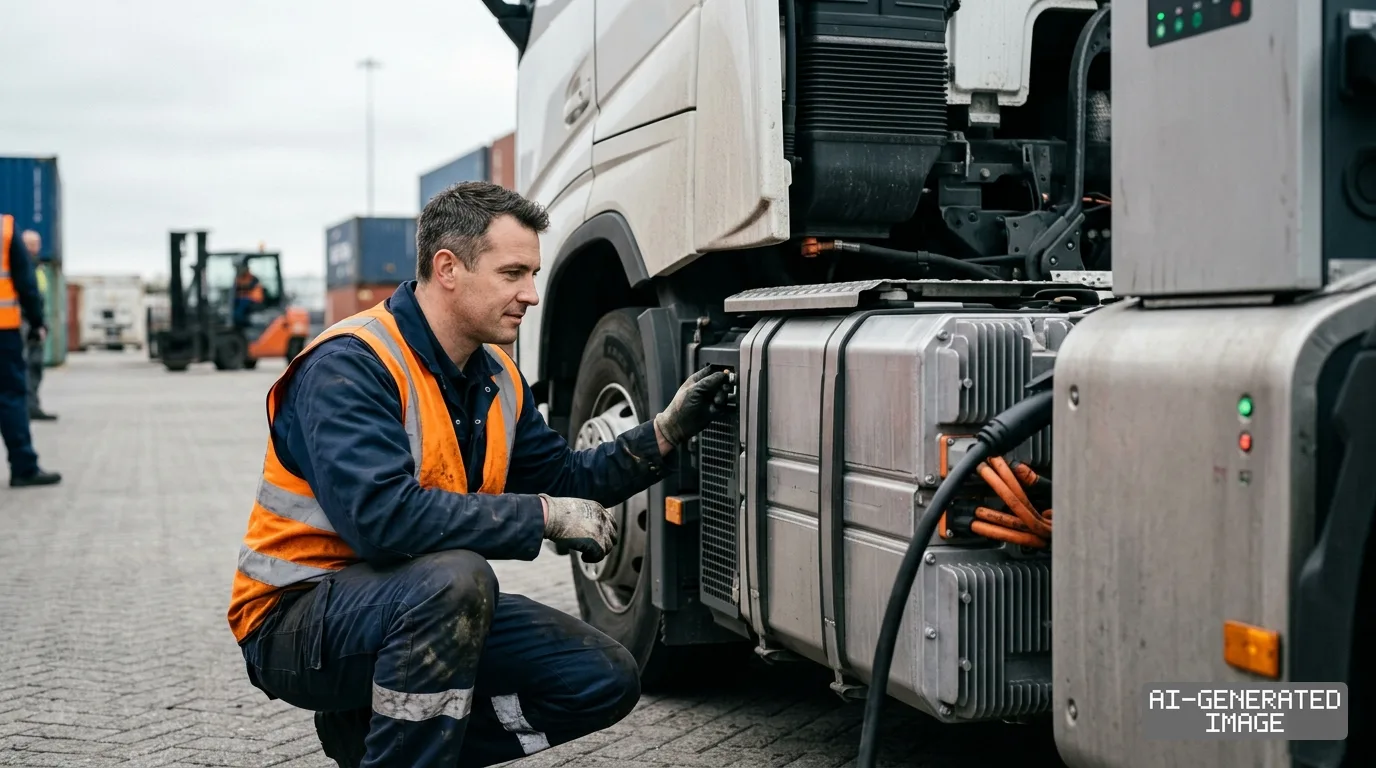
*A worker inspects the battery pack of an electric commercial truck connected to a charging station at a shipping yard. (AI-generated image)*
Contemporary Amperex Technology concluded European roadshow briefings on Sept. 27 for its TECTRANS II battery, following its Sept. 14 launch at IAA Transportation in Hanover.
The platform targets heavy-duty electric trucks with a modular layout that supports driving ranges of up to 1,000 kilometers. That configuration allows long-haul freight carriers to schedule international routes without intermediate charging stops.
The system delivers a gravimetric energy density of 170 Wh/kg, which is 13% above the commercial vehicle industry average. The lighter pack architecture frees about 0.6 metric tons of additional payload capacity at an identical battery volume.
Freight operators face strict axle-load limits on trans-European transport corridors. A weight reduction of 0.6 tons translates directly into higher cargo revenue per journey across regional highway networks.
The platform supports megawatt-level ultrafast charging that refills 80% of pack capacity in 25 minutes. That speed aligns vehicle replenishment with mandatory driver rest intervals mandated under European Union road safety regulations.
Round-trip energy efficiency reaches 96% under standard duty cycles. Higher electrochemical efficiency reduces power losses during high-voltage throughput, directly lowering operational power procurement expenses for fleet logistics terminals.
The heavy-duty truck configuration carries a design life of 12 years and 1.5 million kilometers. The pack retains at least 70% of its initial energy capacity across that operational lifespan.
Extended durability targets high-mileage freight applications, where diesel commercial tractors run continuous multi-shift operations. A 1.5 million-kilometer lifespan allows logistics fleets to amortize vehicle purchase costs across the full commercial life of the chassis.
Physical protection relies on a hot-stamped upper steel enclosure engineered to withstand a 180-kilogram localized load across 10,000 mechanical fatigue cycles. That structure shields cell modules from direct cab distortion during road stress.
The chassis underbody incorporates an armored bottom plate rated for 1,000 joules of impact energy. That barrier prevents puncture damage from high-velocity road debris and uneven loading ramps at freight yards.
Lateral structural rails resist side compression loads of up to 250 kilonewtons. That strength prevents module deformation during lateral vehicle collisions and satisfies strict commercial crashworthiness benchmarks across Western Europe.
Standardized packaging allows the system to interface with both distributed electric axles and centralized drive configurations. The physical architecture also permits flexible operational transitions between standard depot plug-in charging and automated battery-swapping stations.
External casing dimensions, high-voltage electrical connectors and digital bus communication protocols remain fixed across multiple commercial form factors. Vehicle manufacturers can update cell chemistry over successive product generations without re-engineering chassis hardpoints.
Standardized pack interfaces reduce vehicle development cycles by 50% for commercial vehicle builders, the company said. The shared modular architecture lowers upfront research and development spending by 60% to 70% compared with bespoke vehicle battery integration.
Automakers can distribute a single chassis platform across regional distribution vans, urban municipal buses and long-haul prime movers. That commonality removes the expense of engineering proprietary pack enclosures for niche freight classes.
CATL held roughly 44% of global electric vehicle battery shipments in the first half of 2026. The Chinese manufacturer is deploying the standardized platform to anchor business-to-business supply relationships with European fleet operators as passenger car battery demand slows.
DHL Group signed a memorandum of understanding with CATL on Sept. 14 to build electrified freight corridors across continental Europe. The logistics carrier operates one of the largest road transport and express parcel distribution fleets in Europe.
The joint initiative pairs CATL battery technology with DHL logistics networks to validate commercial vehicle deployments on cross-border highway lanes. The partners plan to test standardized packs alongside vehicle manufacturers and specialized charging network operators.
Standardized pack geometry locks transport companies into CATL battery standards ahead of rival modular formats. Competing cell producers in South Korea and Japan face higher barriers when bidding for shared fleet architectures across unified European transport corridors.
Fleet operators evaluate total cost of ownership rather than retail brand cachet when acquiring heavy-duty haulage equipment. A standardized pack format creates lasting operational switching costs once transport hubs build out compatible megawatt chargers and swapping gantries.
The company has not disclosed the initial battery pack supply price, the production start date for commercial volumes, or binding volume commitments from European truck makers. CATL also omitted technical chemistry details regarding the cathode formulation used inside the cells.
Field deployments under the green freight corridor partnership with DHL Group will start on designated continental European test corridors in early 2027.
## Impact map
| Event | Korea | China | Japan | Global impact |
| --- | --- | --- | --- | --- |
| TECTRANS II European commercial vehicle launch | LG Energy Solution and Samsung SDI face standardized pack competition in European bus and truck tenders | CATL expands its 44% global volume lead into European heavy transport corridors | Panasonic remains focused on light passenger cells, leaving European truck fleets to modular Chinese packs | Commercial fleet operators cut electric truck development cycles by 50% and gain 0.6 tons of payload |
## In this story
- **Companies:** Contemporary Amperex Technology
- **Tickers:** 300750.SZ
- **Exposed:** DHL Group
- **Policy:** Economic Security
- **Impact:** Supply Chain, Cost Structure
## Primary sources
1. cleantechnica.com
2. catl.com
3. zdnet.co.kr
4. batterydesign.net
5. carnewschina.com
---
Cite as: East Asia Brief, "CATL launches TECTRANS II battery to anchor European trucks," September 27, 2026. https://eastasiabrief.com/batteries-ev/catl-launches-tectrans-ii-battery-anchor-european-trucks-396