# BYD tests Ti7 in Canada with second-generation Blade battery
*A leaked evaluation sheet shows an all-wheel-drive plug-in hybrid setup that the Shenzhen automaker has not deployed in its Chinese domestic lineup.*
**Published:** September 8, 2026
**By:** Lian Chen
**Section:** Batteries & Electric Vehicles — China
**Format:** Breaking
**Confidence:** medium
**Source:** https://eastasiabrief.com/batteries-ev/byd-tests-ti7-canada-second-generation-blade-battery-214
**Publisher:** East Asia Brief (https://eastasiabrief.com/)
---
## What to know
- BYD tested an export-spec Ti7 plug-in hybrid SUV in Canada with its second-generation Blade battery, according to vehicle documentation photographed in Toronto and published on Sept.
- The Shenzhen automaker established BYD Canada Company Limited in Markham, Ontario to prepare passenger vehicle distribution.
- The spec sheet was photographed inside a test vehicle at the Sheraton Centre parking structure in Toronto.
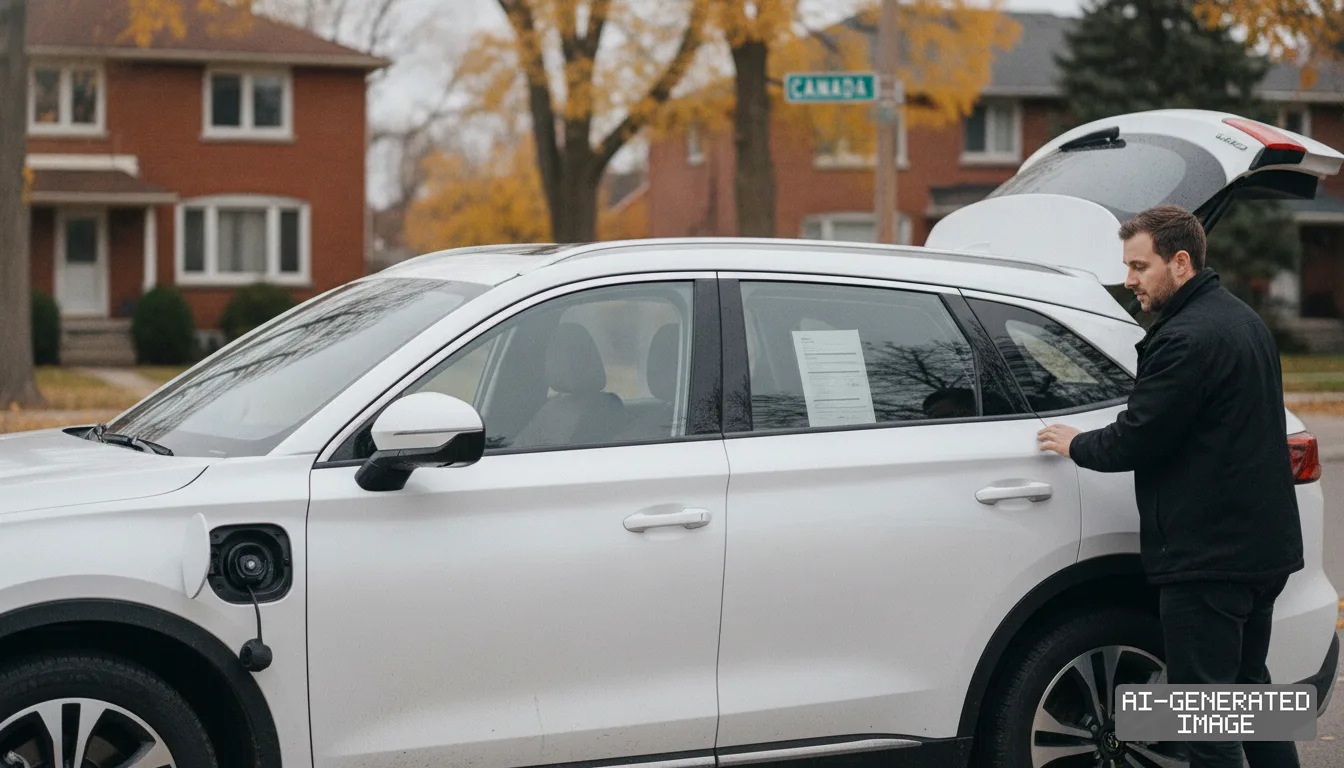
*A man stands beside a white plug-in hybrid SUV displaying vehicle documentation in its window along a street in Canada. (AI-generated image)*
BYD tested an export-spec Ti7 plug-in hybrid SUV in Canada with its second-generation Blade battery, according to vehicle documentation photographed in Toronto and published on Sept. 8, 2026.
The Shenzhen automaker established BYD Canada Company Limited in Markham, Ontario to prepare passenger vehicle distribution. The unit is currently recruiting regional dealers and evaluating models for nationwide import.
The spec sheet was photographed inside a test vehicle at the Sheraton Centre parking structure in Toronto. The document identified the vehicle as a four-wheel-drive plug-in hybrid electric SUV.
The sighting follows earlier test runs recorded in Montreal and Markham during late August. Those earlier vehicles included the Sealion 7 electric SUV and an unbadged camouflaged prototype carrying Ontario manufacturer plates.
The Ti7 sells in China under BYD's off-road sub-brand, Fangchengbao, as the Bao 7. The vehicle uses a dual-motor electric layout paired with a turbocharged gasoline engine to extend driving range.
BYD unveiled the second-generation Blade battery on March 5, 2026 during a technology presentation in Shenzhen. Chairman Wang Chuanfu presented the cell as the company's flagship energy storage platform for high-end vehicles.
The updated pack uses lithium manganese iron phosphate chemistry, an upgrade over standard lithium iron phosphate cells. The chemistry lifts gravimetric cell density to between 190 and 210 watt-hours per kilogram.
The battery architecture supports 1,500-kilowatt direct-current charging at 1,000 volts. Under factory testing, the system charges a battery pack from 10% to 97% capacity in nine minutes.
The chemistry maintains operating efficiency at minus 30 degrees Celsius, according to company presentation slides. That thermal resistance directly targets cold-weather range degradation, a persistent obstacle for electric vehicles in Canada.
In China, BYD restricts the second-generation Blade battery exclusively to pure battery electric vehicles. The company installed the pack in 10 electric models, including the Ti7 EV Flash Charge Edition launched on April 29.
No plug-in hybrid sold in the Chinese domestic market carries the second-generation battery. Chinese hybrid buyers receive earlier lithium iron phosphate cells, reserving the advanced pack for higher-margin electric cars.
Pairing the advanced cell with a hybrid powertrain creates a configuration built specifically for export buyers. The layout addresses long highway distances and harsh winter temperatures across rural Canadian provinces.
The hybrid setup targets North American demand for high-range SUVs without complete dependence on public charging stations. Japanese automakers currently dominate Canadian hybrid deliveries with conventional nickel and lithium-ion packs.
Canada opened an import quota permitting up to 49,000 Chinese-built electrified passenger vehicles under reduced duties. The federal program counts battery electric models, standard hybrids and plug-in hybrids against the same allotment.
Transport Canada maintains a public registry of approved foreign vehicle manufacturing facilities. The agency currently lists BYD assembly plants located in Shenzhen and Xi'an for Canadian compliance pre-clearance.
BYD builds the Ti7 line at assembly plants in Changsha, Hefei and Jinan. None of those three production sites appears on the Transport Canada approved registry, according to government records.
Vehicles built at unlisted plants cannot enter commercial showroom channels or obtain final retail registration. The manufacturer must complete administrative plant audits and vehicle safety filings before retail deliveries can begin.
Transport regulations permit manufacturers to import uncertified prototypes for engineering evaluation and climatic testing. Temporary test permits allow road operation without granting authorization for commercial retail sales.
The leaked specification sheet does not prove that the physical test car carries the second-generation pack. BYD has not confirmed whether the Toronto prototype houses operational production cells or older prototype packs.
BYD has not announced whether it will commit this hybrid powertrain combination to mass assembly lines. Evaluation vehicles frequently test component combinations that automakers ultimately discard before retail production.
BYD Canada declined to confirm the leaked document or discuss specific model timelines for local showrooms. The company maintains that final Canadian model selections remain subject to ongoing market feasibility reviews.
The next checkable step rests with Transport Canada's pre-clearance register. The inclusion of the Changsha, Hefei or Jinan assembly plants will indicate whether BYD intends to homologate the Ti7 for Canadian retail buyers.
## Impact map
| Event | Korea | China | Japan | Global impact |
| --- | --- | --- | --- | --- |
| BYD Ti7 PHEV Canada testing leak | LG Energy Solution and SK On face LFP energy density competition in export SUV segments | BYD tests overseas-only PHEV powertrain split with next-generation LMFP chemistry | Toyota hybrid dominance in Canadian utility segments faces 1,500 kW fast-charge PHEV rival | North American automakers face low-cost Chinese PHEVs pairing 190-210 Wh/kg cells with cold-weather capability |
## In this story
- **Companies:** BYD
- **Tickers:** 002594.SZ, 1211.HK
- **Exposed:** Transport Canada, CATL
- **Policy:** Tariffs, Economic Security
- **Impact:** Supply Chain, Order Book, Pricing
## Primary sources
1. eletric-vehicles.com
2. globalchinaev.com
3. danawa.com
4. battery-tech.net
5. bydcarchina.com
---
Cite as: East Asia Brief, "BYD tests Ti7 in Canada with second-generation Blade battery," September 8, 2026. https://eastasiabrief.com/batteries-ev/byd-tests-ti7-canada-second-generation-blade-battery-214