# BYD readies solid-state battery road trial as rivals advance
*The Chinese automaker clarified its deployment schedule following reports of road trials, confirming a demonstration run ahead of Samsung SDI and Toyota.*
**Published:** September 27, 2026
**By:** Lian Chen
**Section:** Batteries & Electric Vehicles — China
**Format:** Why It Matters
**Confidence:** medium
**Source:** https://eastasiabrief.com/batteries-ev/byd-readies-solid-state-battery-road-trial-rivals-advance-394
**Publisher:** East Asia Brief (https://eastasiabrief.com/)
---
## What to know
- BYD plans 1,000-vehicle solid-state trial fleet between 2027 and 2029
- Samsung SDI allocates 16 trillion won ($11.6 billion) to Ulsan for 2027 production
- Commercial mass adoption across global automakers remains anchored to 2030
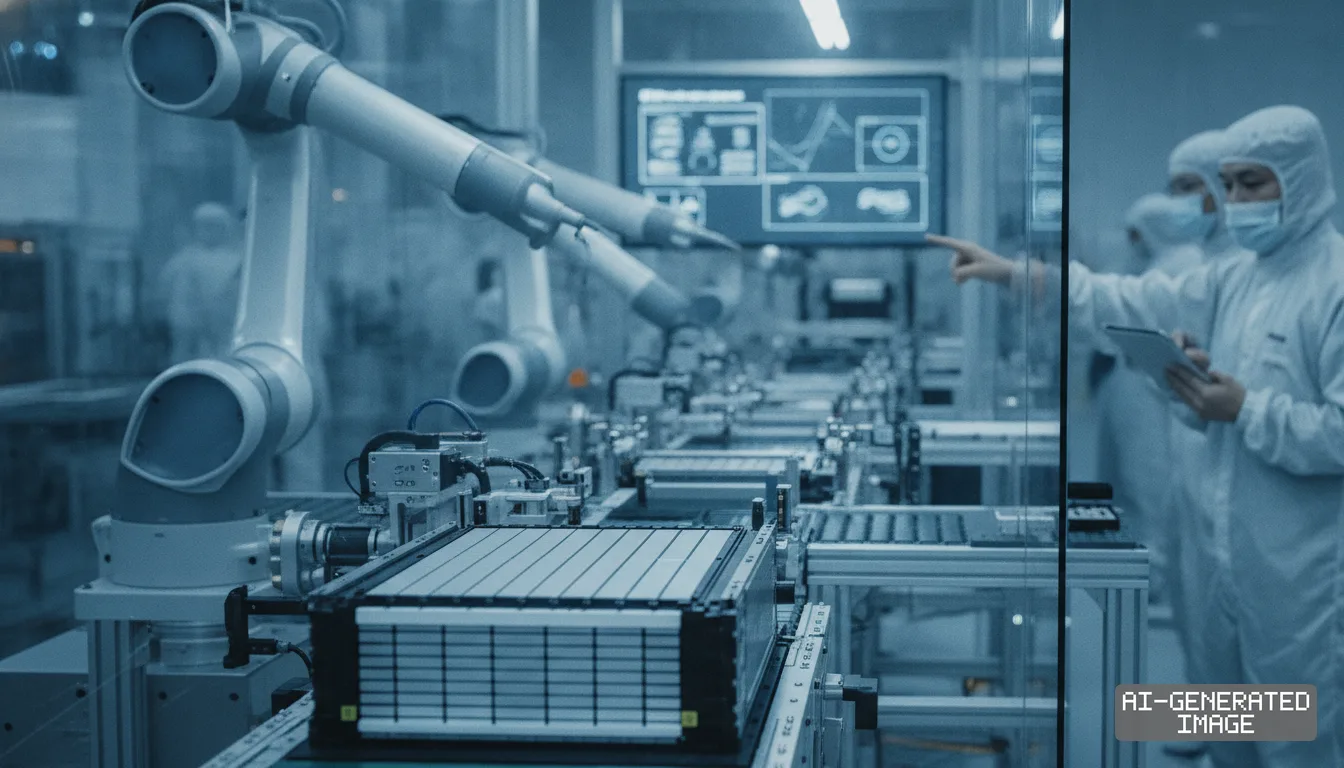
*Robotic arms assemble battery packs on an automated production line while technicians in cleanroom suits monitor the manufacturing process. (AI-generated image)*
BYD reiterated plans on Sept. 27, 2026 to deploy its first solid-state battery demonstration vehicle next year, clarifying that the project remains a limited road trial rather than retail mass production.
The Shenzhen-based automaker, the world's largest electric vehicle manufacturer by volume, operates an integrated battery subsidiary, FinDreams Battery, which supplies cells across its commercial lineup.
FinDreams is engineering solid-state prototypes targeting an energy density of 400 watt-hours per kilogram, more than double the 150 watt-hours per kilogram delivered by BYD's standard lithium iron phosphate Blade cells.
The demonstration model will validate proprietary battery packs in real operating conditions during 2027, Executive Vice President Stella Li said in an interview with automotive channel Carwow.
Li stated that BYD holds a leading position in both chemistry research and equipment tooling, but declined to provide vehicle specifications, model designations or pricing data.
The executive emphasized that early test vehicles are engineered to verify manufacturing processes and equipment integration rather than enter consumer showrooms for high-volume retail delivery.
Her remarks align with an institutional roadmap disclosed at the Second China All-Solid-State Battery Innovation and Development Summit in February 2025.
FinDreams Chief Technology Officer Sun Huajun said at the summit that the company plans to deploy roughly 1,000 demonstration vehicles between 2027 and 2029.
The company expects widespread commercial mass production to begin around 2030, when supply chains for raw materials and specialized manufacturing tools reach scale, Sun said.
Initial trial packs will be installed on high-end vehicle platforms, including BYD's luxury Yangwang brand and flagship Denza models, where premium pricing absorbs high initial cell costs.
FinDreams is focusing on an inorganic sulfide solid electrolyte based on lithium phosphorus sulfur chlorine, a chemistry known for high ionic conductivity.
Solid-state cells replace volatile liquid electrolytes with solid separators to prevent thermal runaway — the uncontrollable temperature spike that causes battery fires — while accelerating charging speeds.
The company has produced 20-ampere-hour and 60-ampere-hour pouch cell prototypes to test chemical stability and structural endurance under sustained mechanical compression.
BYD operates a 2-gigawatt-hour pilot production line in the Pingshan district of Shenzhen for cell process validation, where manufacturing yields have reached initial testing thresholds.
The company is also preparing a 20-gigawatt-hour initial phase at its Bishan industrial base in Chongqing to support subsequent demonstration output.
China's Ministry of Industry and Information Technology implemented the country's first national standard for automotive solid-state batteries, GB/T 43568, in July 2026.
The standard defines fully solid-state batteries as cells with liquid electrolyte content below 5% and a weight-loss rate under 0.5% after six hours of vacuum baking at 120 degrees Celsius.
Prototype road tests evaluated by the China Automotive Technology and Research Center demonstrated a driving range exceeding 1,200 kilometers under China Light-Duty Vehicle Test Cycle conditions.
However, sulfide electrolytes face severe engineering hurdles, including interface degradation as cathode materials expand and contract during lithiation — the insertion of lithium ions during charging.
Solid-solid interfaces can lose mechanical contact over repeated duty cycles, causing internal resistance to rise and accelerating capacity fade.
To counter interface degradation, China's National Intellectual Property Administration published a BYD patent, CN122474592A, on July 28, 2026 detailing a dual-electrolyte cathode structure designed to improve cycle durability.
Maintaining constant mechanical stack pressure in automotive packs requires rigid containment casings, which add structural dead weight and offset the gravimetric advantage of sulfide cells.
Precursor materials also present severe cost barriers, with synthesized lithium sulfide trading above $1,000 per kilogram due to delicate processing requirements in moisture-free dry rooms.
Samsung SDI is running on a parallel schedule, having confirmed plans to begin mass production of sulfide-based all-solid-state cells in the second half of 2027.
The South Korean cell maker is allocating 16 trillion won ($11.6 billion) to expand its Ulsan complex as part of a 25 trillion won domestic investment blueprint through 2040.
Samsung SDI is targeting a volumetric energy density above 900 watt-hours per liter, shipping trial samples to automotive and robotics manufacturers from its Suwon pilot line.
South Korea's Ministry of Trade, Industry and Energy pledged 117.2 billion won ($85 million) through 2028 to co-fund next-generation battery development across domestic cell makers.
Rival producers LG Energy Solution and SK On are prioritizing composite and semi-solid chemistries, slating full sulfide mass production closer to 2030.
Toyota Motor is targeting commercial vehicle introduction between 2027 and 2028, partnering with Japanese refiner Idemitsu Kosan to build a dedicated lithium sulfide supply chain.
Idemitsu Kosan is constructing a pilot facility in Japan designed to produce 1,000 metric tons of sulfide electrolyte annually by 2027 to support Toyota's assembly lines.
Sumitomo Metal Mining is preparing to mass-produce compatible high-nickel cathode materials for Toyota by fiscal 2028, securing core inputs for high-performance Lexus electric models.
Contemporary Amperex Technology, the world's largest battery manufacturer with about 37% of global EV cell capacity, has scheduled its full solid-state battery commercialization for around 2030.
CATL is deploying semi-solid cells containing reduced liquid electrolyte volumes as an interim step to bridge consumer range requirements without incurring full solid-state production overhead.
Global solid-state cell shipments will reach 122 gigawatt-hours by 2030, representing roughly 1.6% of the total vehicle battery market, according to projections by research firm SNE Research.
BYD has not published pack-level energy specifications, vehicle curb weight, or the specific passenger model name designated for the 2027 demonstration run.
FinDreams is scheduled to deploy its initial 1,000-vehicle trial fleet between 2027 and 2029 before opening large-scale commercial assembly lines in 2030.
## Impact map
| Event | Korea | China | Japan | Global impact |
| --- | --- | --- | --- | --- |
| Solid-State Battery Commercialization | Samsung SDI targets H2 2027 Ulsan line under 16 trillion won commitment | BYD plans 1,000-unit trial fleet in 2027 before 2030 mass scaling | Toyota and Idemitsu target 2027-2028 Lexus launch with 1,000-ton electrolyte plant | SNE Research projects solid-state cells take 1.6% of EV market by 2030 |
| Solid-State Battery Commercialization | Samsung SDI targets H2 2027 Ulsan line under 16 trillion won commitment | BYD plans 1,000-unit trial fleet in 2027 before 2030 mass scaling | Toyota and Idemitsu target 2027-2028 Lexus launch with 1,000-ton electrolyte plant | SNE Research projects solid-state cells take 1.6% of EV market by 2030 |
## In this story
- **Companies:** BYD, Samsung SDI, Toyota Motor
- **Tickers:** 002594.SZ, 006400.KS, 7203.T
- **Exposed:** Contemporary Amperex Technology, Idemitsu Kosan, Sumitomo Metal Mining
- **Policy:** Economic Security, Subsidies
- **Impact:** Supply Chain, Capex, Cost Structure
## Primary sources
1. engadget.com
2. bydglobal.com
3. businesspost.co.kr
4. carnewschina.com
5. g-enews.com
---
Cite as: East Asia Brief, "BYD readies solid-state battery road trial as rivals advance," September 27, 2026. https://eastasiabrief.com/batteries-ev/byd-readies-solid-state-battery-road-trial-rivals-advance-394