# BAIC Motor puts 112 battery swap stations up for public auction
*The Beijing automaker will offload 277.9 million yuan of swap infrastructure as parent BAIC Group shifts vehicle fleets to CATL's shared charging network.*
**Published:** November 18, 2026
**By:** Lian Chen
**Section:** Batteries & Electric Vehicles — China
**Format:** Breaking
**Confidence:** medium
**Source:** https://eastasiabrief.com/batteries-ev/baic-motor-puts-112-battery-swap-stations-up-public-1536
**Publisher:** East Asia Brief (https://eastasiabrief.com/)
---
## What to know
- BAIC Motor lists 112 swap stations for auction at 277.9 million yuan ($41.4 million) floor price
- Parent BAIC Group shifts fleet to CATL's Choco-Swap network targeting 1 million vehicles
- Disposal notice to reach Beijing Equity Exchange by the end of November 2026
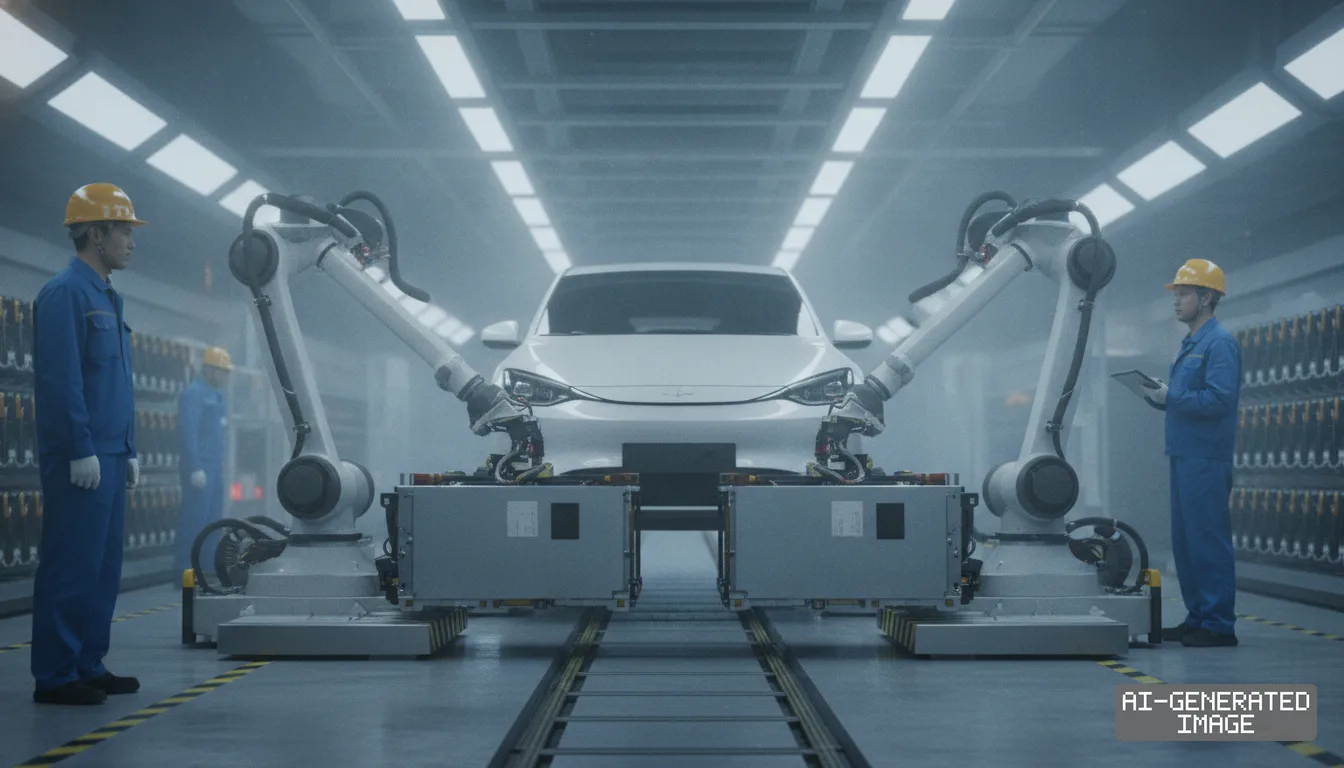
*Robotic arms position battery packs beside an electric vehicle as technicians monitor the process inside an automated battery swap facility. (AI-generated image)*
BAIC Motor said Nov. 18 it will auction 112 battery swap stations through the China Beijing Equity Exchange, offloading legacy assets as its parent company integrates vehicles into CATL's shared charging network.
The wholly owned subsidiary Beijing BAIC Powertrain plans to dispose of its entire interest in the station portfolio. The package includes operating inventory, physical machinery, construction in progress and related intangible software licenses.
An asset valuation report appraised the portfolio at 277.9 million yuan ($41.4 million) excluding tax. That cost-approach assessment sits 1.54% above the unaudited book value of roughly 274 million yuan ($40.8 million).
The appraised valuation establishes the minimum floor price for the upcoming open tender. Across the 112 targeted stations, the appraised benchmark equates to approximately 2.48 million yuan ($370,000) per individual battery swapping facility.
BAIC Motor estimates that completing the divestment at the baseline appraised value would raise its consolidated net profit by 3.52 million yuan ($524,000) after transaction costs. Net proceeds will fund general corporate development, the automaker said.
The state-backed manufacturer is moving the assets through the municipal property exchange to comply with state-owned enterprise disposal rules. The open bidding structure requires public registration before any equity or property transfer can occur, the company said.
The disposal follows a strategic cooperation pact signed Oct. 22 by parent Beijing Automotive Group and Contemporary Amperex Technology Co., Limited. BAIC Chairman Zhang Jianyong and CATL Chairman Robin Zeng signed the partnership in Beijing.
The agreement aims to deploy one million battery-swappable passenger vehicles across China. Under the pact, BAIC agreed to connect several sub-brands to CATL's Choco-Swap architecture and open showroom dealership real estate for station construction.
Battery swapping — the mechanical replacement of a depleted pack with a charged unit within minutes — separates vehicle ownership from the battery. The model allows buyers to lease the battery pack, lowering upfront retail vehicle costs.
BAIC's premium electric brand Arcfox introduced two production models using CATL's swappable battery architecture on Nov. 13. The company launched swap-capable editions of the Beta S3 compact crossover and the Beta T1 electric SUV.
BAIC was one of China's earliest adopters of dedicated battery-swap stations, deploying proprietary infrastructure for municipal taxi fleets starting in 2015. The municipal taxi operations relied on specialized stations built by affiliate Beijing Blue Park Smart Energy.
In March 2025, BAIC Powertrain acquired 40 stations from Blue Park Smart Energy for 129 million yuan ($19.2 million). That transaction valued each station at 3.23 million yuan ($480,000), roughly 30% above the current auction appraisal benchmark.
Building proprietary swapping networks created substantial capital liabilities for automakers without generating sufficient throughput. Low station utilization across fleet-specific designs forced operators to carry depreciating real estate, battery inventories and utility grid upgrade costs.
By outsourcing network infrastructure to CATL, carmakers convert fixed property investments into service agreements. CATL operates the battery service platform through its subsidiary, Contemporary Amperex Energy Service, commonly known as CAES, the battery manufacturer said.
CATL reported operating 2,520 passenger car swap stations across China by Sept. 29. The world's largest battery manufacturer plans to exceed 3,000 operational swap stations across 190 Chinese cities by the end of 2026.
Electric vehicle maker Nio Inc. operates China's largest battery-swap network, managing 4,254 operational swap stations as of Nov. 13. However, CATL's aggressive capital spending threatens to reshape the commercial balance across the domestic charging landscape.
CATL plans to double its network to 6,000 swap stations across 297 Chinese cities during 2027. That target includes 5,000 urban swapping stations and 1,000 highway hubs positioned along 20 national expressway corridors.
Other Chinese automakers have also tied their product pipelines to CATL's battery design. Chery Automobile signed a strategic cooperation agreement with CATL in April to build swappable passenger vehicles compatible with the Choco-Swap standard.
The Hong Kong regulatory filing does not identify a bidder or prospective purchaser, and BAIC Powertrain has not executed a binding transfer agreement. The filing also does not confirm whether CATL intends to bid.
BAIC Powertrain plans to submit the formal disposal application to the China Beijing Equity Exchange by the end of November 2026. The exchange will then publish bidding qualification criteria and auction deadlines.
The public listing will test commercial appetite for legacy swap assets as Chinese automakers retreat from operating proprietary charging infrastructure. Bidding results will establish market prices for second-hand urban charging real estate.
## Impact map
| Event | Korea | China | Japan | Global impact |
| --- | --- | --- | --- | --- |
| BAIC swap asset auction | Hyundai Motor joint venture keeps standard charging while BAIC isolates swap liabilities | CATL accelerates network dominance as legacy OEM swap assets head to auction | Toyota and Honda maintain charging-only product lines in Chinese EV market | Automakers abandon proprietary swap networks as battery makers control BaaS infrastructure |
## In this story
- **Companies:** BAIC Motor, CATL
- **Tickers:** 01958.HK, 300750.SZ
- **Exposed:** Nio
- **Impact:** Capex, Supply Chain
## Primary sources
1. carnewschina.com
2. cfi.net.cn
3. cnevpost.com
4. battery-tech.net
5. sina.com.cn
---
Cite as: East Asia Brief, "BAIC Motor puts 112 battery swap stations up for public auction," November 18, 2026. https://eastasiabrief.com/batteries-ev/baic-motor-puts-112-battery-swap-stations-up-public-1536